Your bag is empty
Add something beautiful to get started
The everyday garment
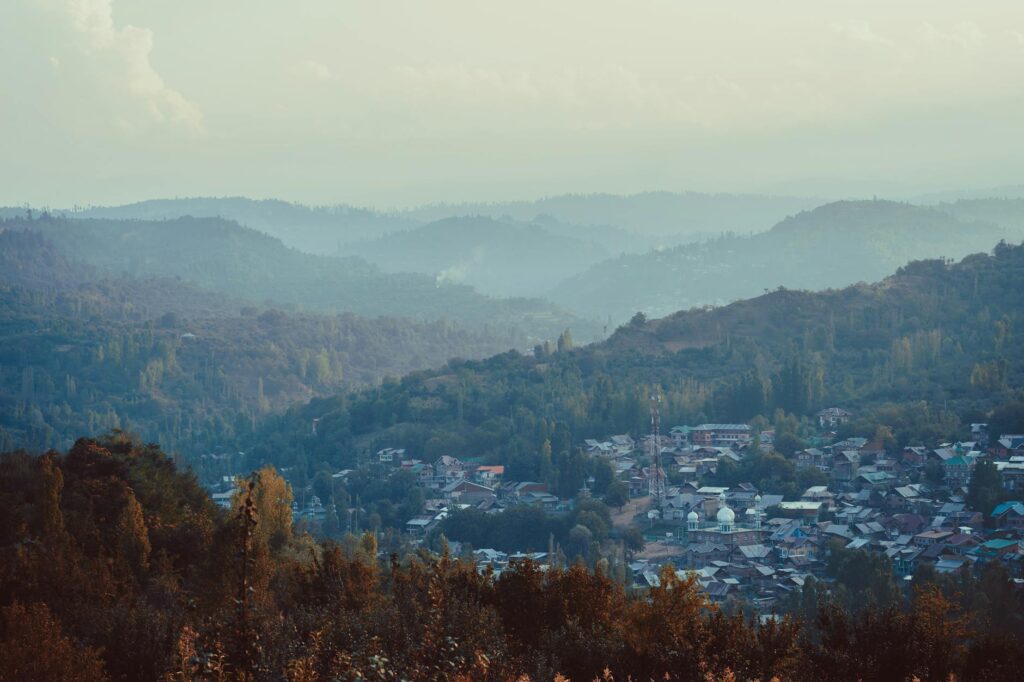
The cotton spinning-wheel and the weavers’ walk are familiar objects in every part of Kashmir.
Walter Lawrence · The Valley of Kashmir · 1895
A Mughal garden in Srinagar from the air, the chinars turned for autumn. The vine, leaf and paisley of the embroidery come from gardens like this one.
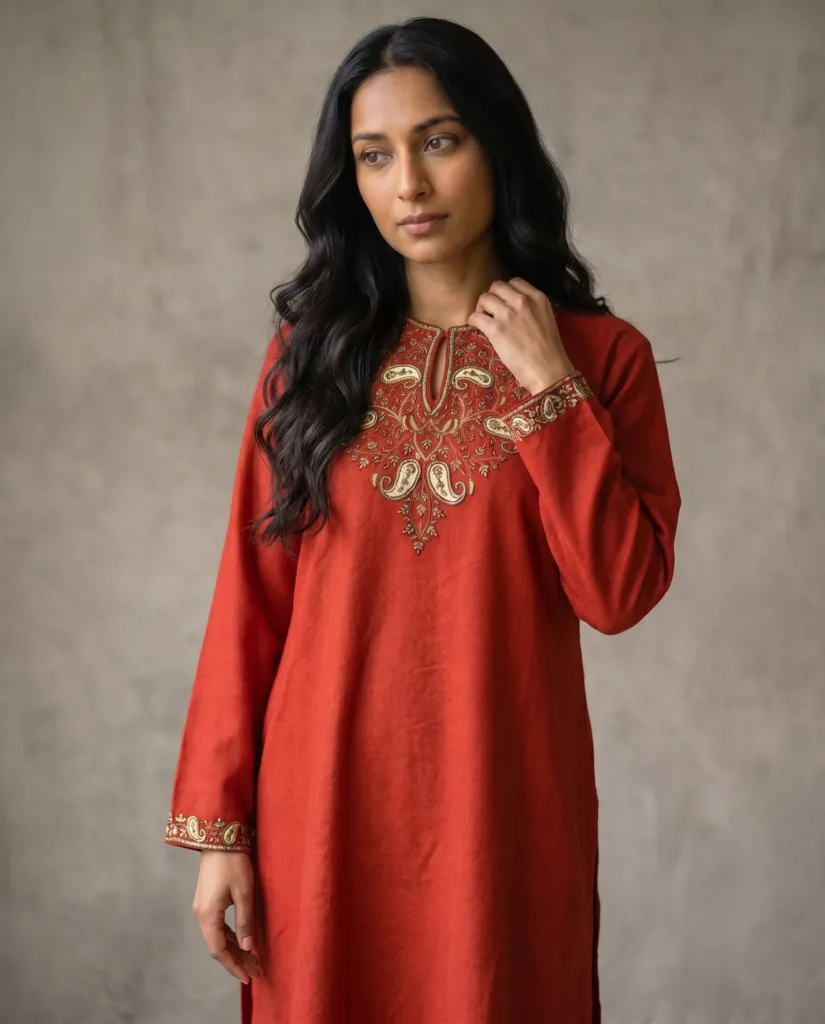
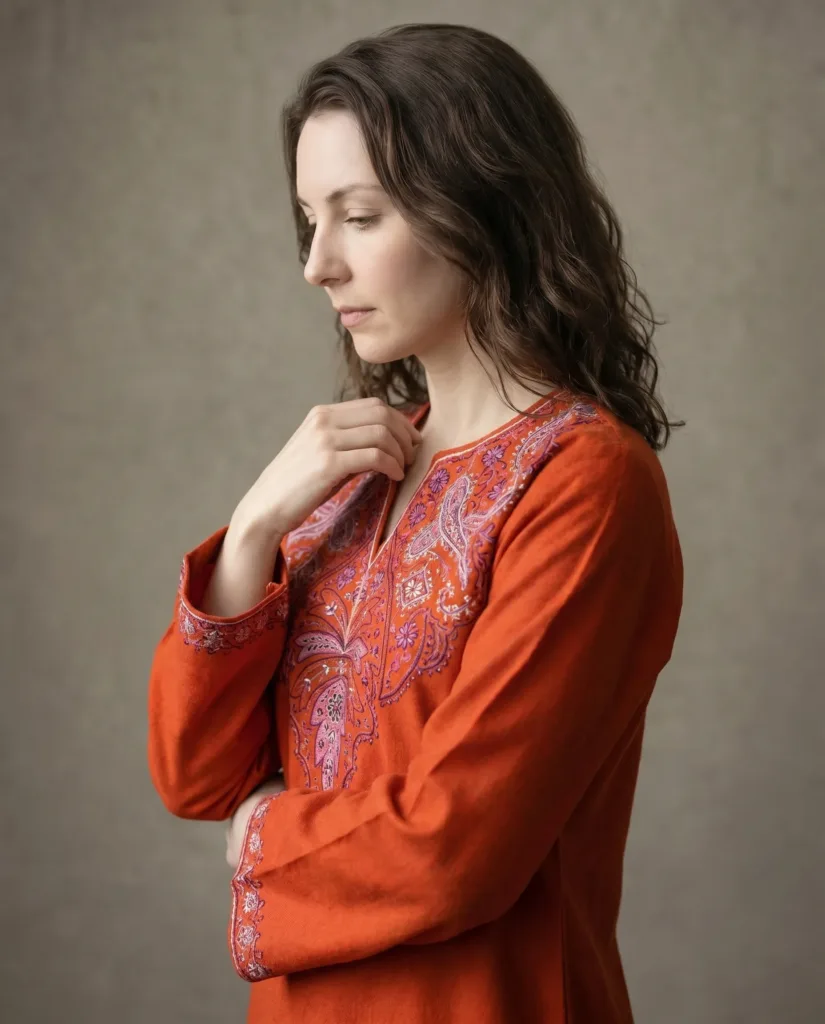
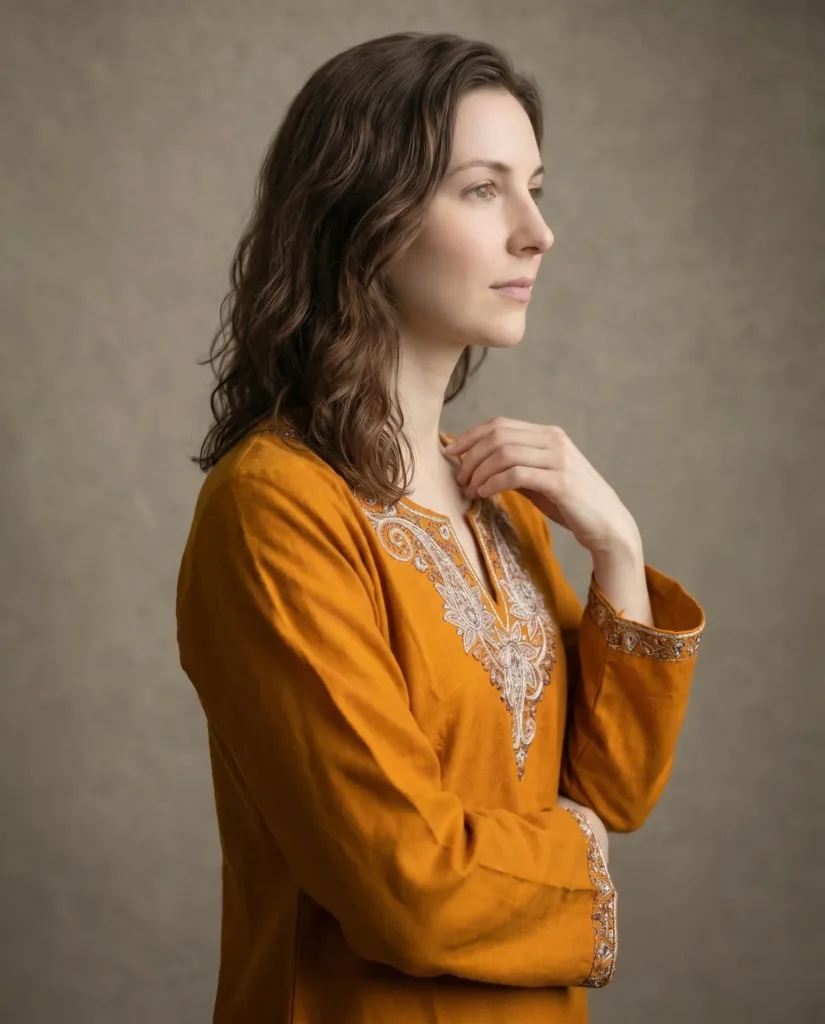
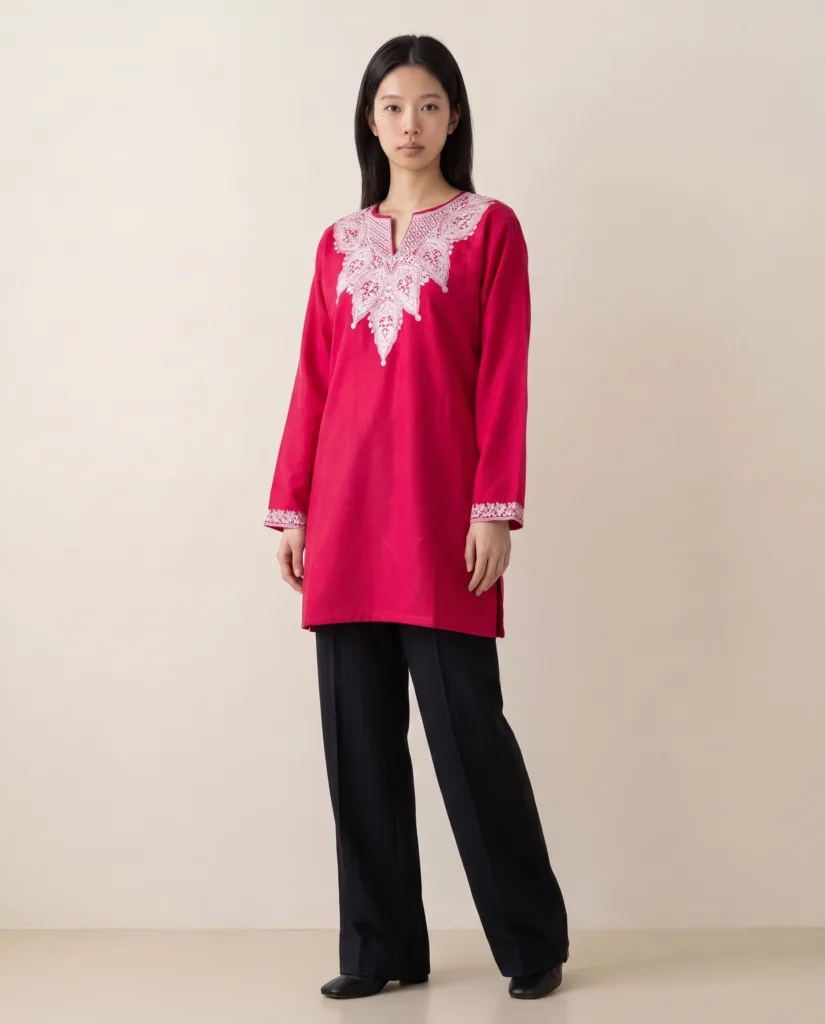
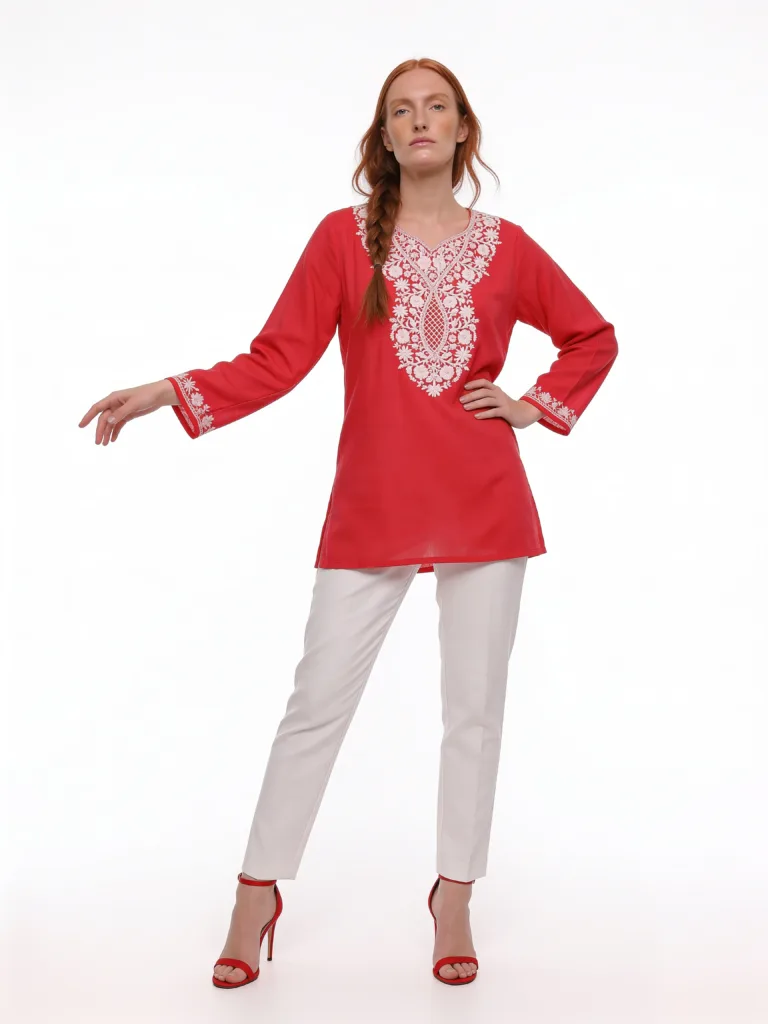
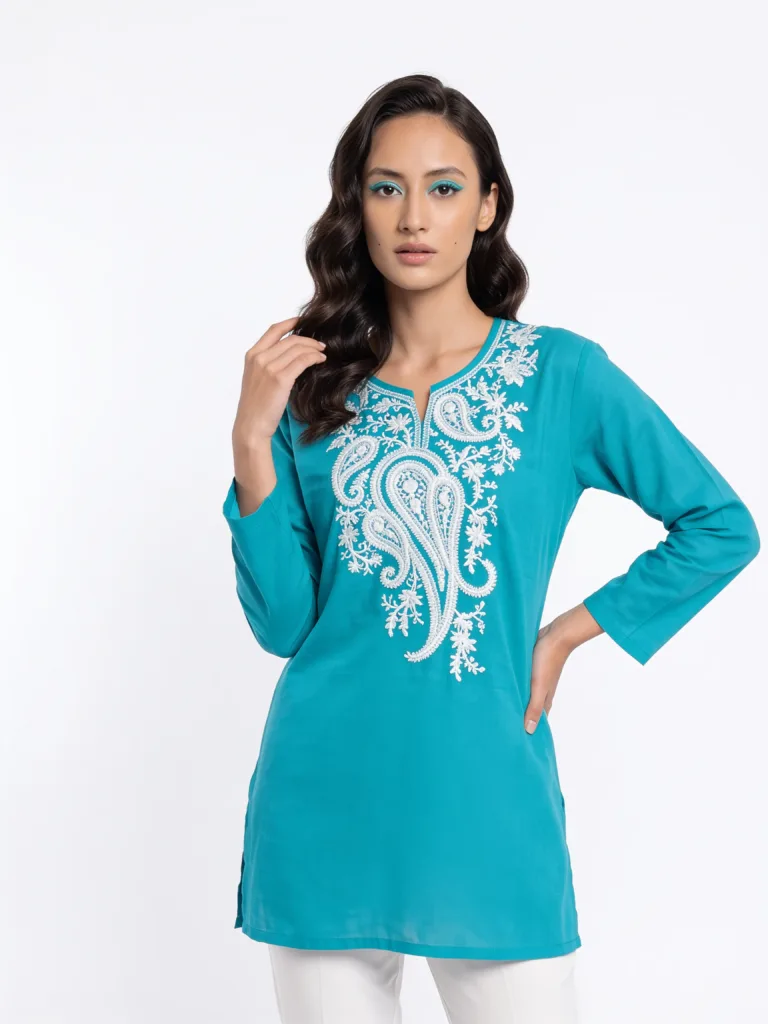
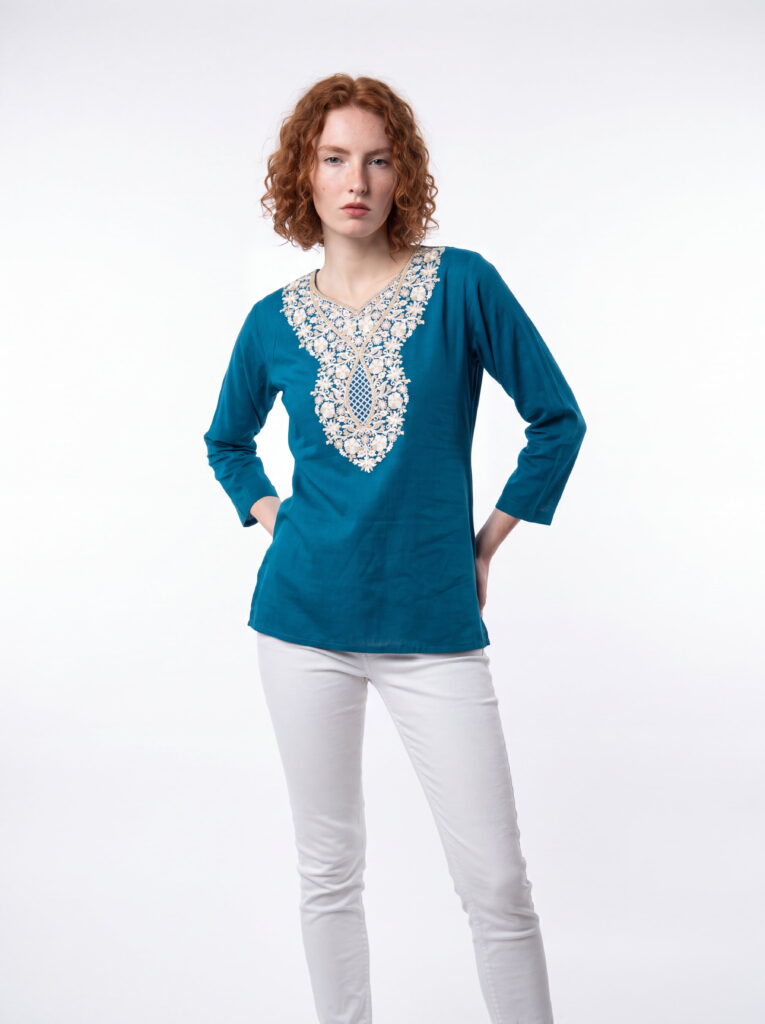
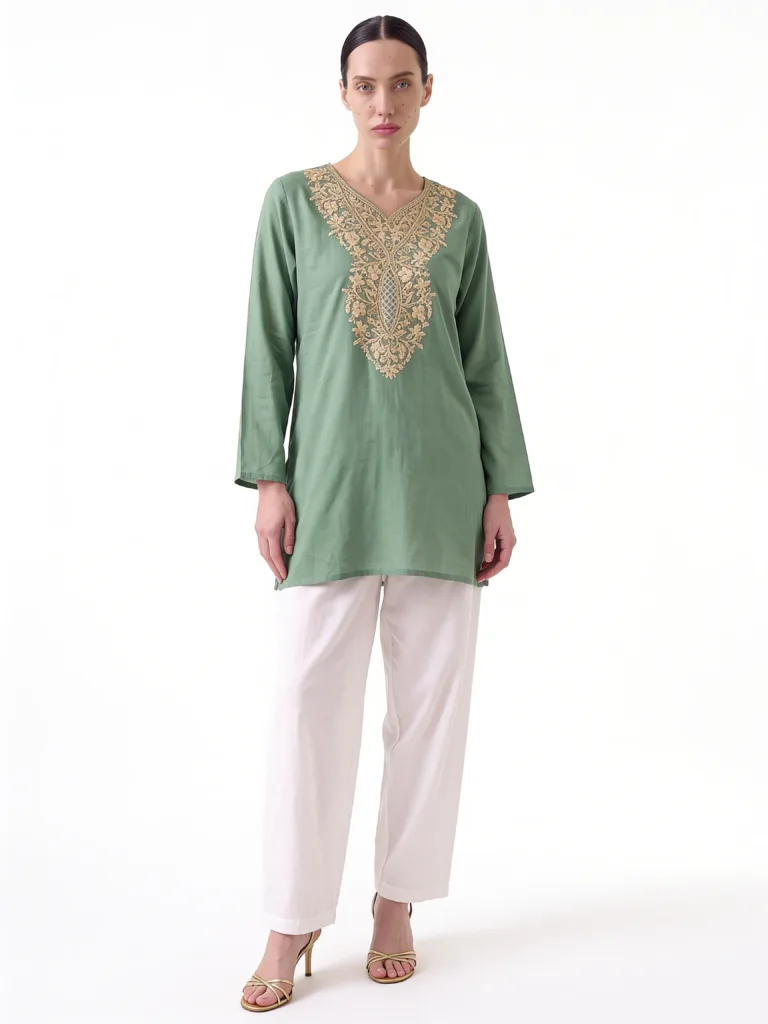
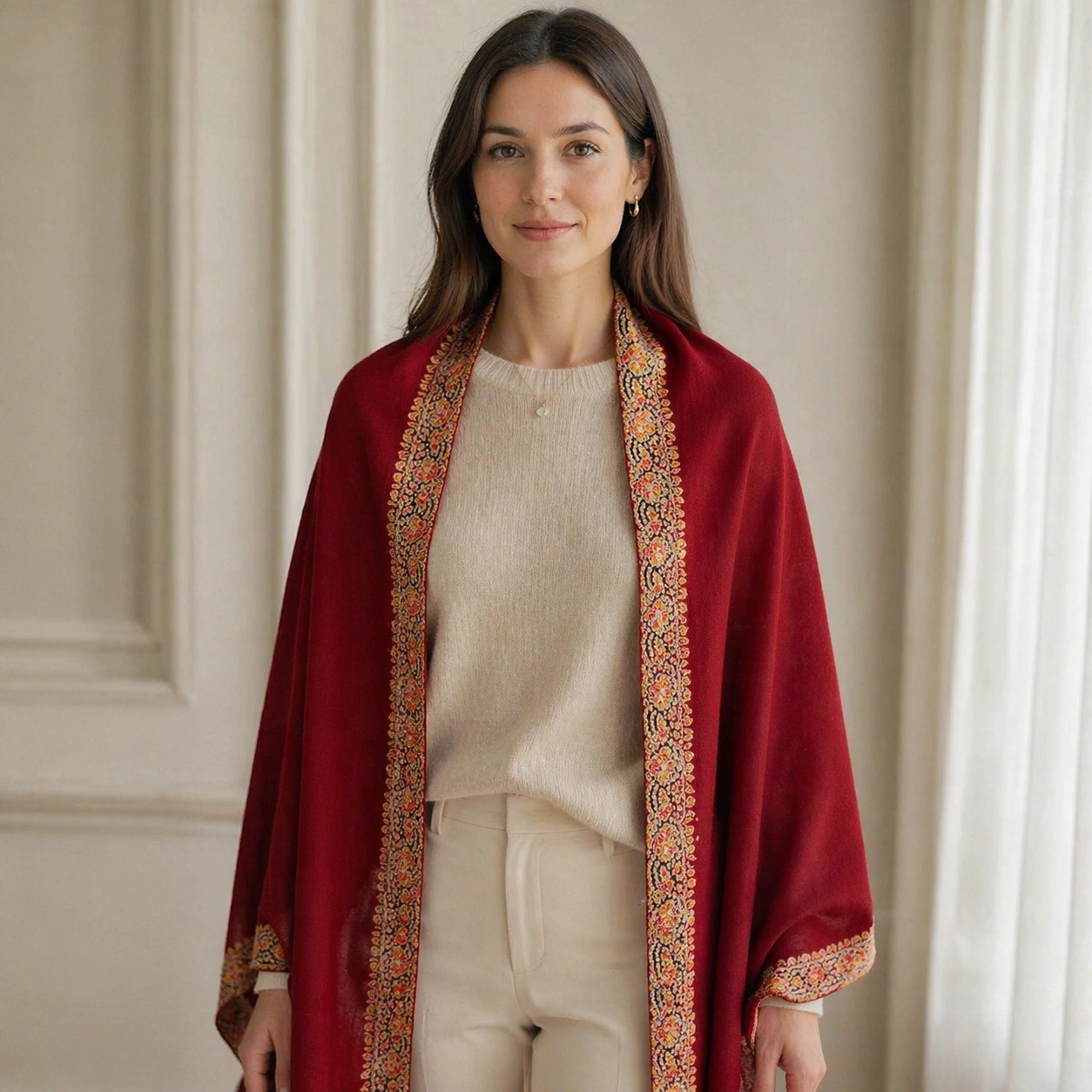
A kurti is the short tunic of South Asia, the women's cut of the kurta, worn over trousers or jeans and long enough to cover the hip. The Kashmiri kurti is that garment with the valley's needlework on it: aari chain stitch or tilla metal thread at the neckline, the cuffs and the hem, in the same vocabulary of vine, leaf and paisley that runs across everything Srinagar makes.
We sell 83 of them, 67 in stock today, in two cloths. The acro wool kurtis, £20 to £25, are the autumn and winter ones, made for a British October. The cotton kurtis, £15 to £20, are for summer and for indoors. Every one is a single size, cut loose, and 27 to 30 inches long. Below: where the word and the cut come from, what the two cloths do, where the needle goes, how to wear one here, and how to wash it.
Part one
The word is Persian. Steingass's dictionary of 1892 gives karta as a tunic, a jacket, a long loose-skirted shirt; Platts's Urdu dictionary of 1884 has kurta as a shirt worn outside the drawers, and kurti, marked Persian, as a bodice or a jacket. Hobson-Jobson, the glossary of Anglo-Indian words, calls them both true P[ersian] words for various forms of jacket or tunic. Today's Oxford definition of kurti is a tunic or shirt worn especially by women in South Asia, shorter and typically more closely fitting than a kurta.
How short is a matter of place and decade. The Victoria and Albert Museum holds a man's muslin kurta from Lucknow of about 1900 at 96 centimetres, and a woman's from the Indus Kohistan, made between 1950 and 1970, at 98. Ours sit at 69 to 76 centimetres, which is the hip or the top of the thigh. In Kashmir the kurti is the youngest child of the pheran. The pheran fell to the feet until the late nineteenth century; the version that stops below the knee is, the Kashmiri press notes, relatively recent; and the kurti is that shortening carried on, with the pheran's embroidery kept exactly where it always sat, at the collar, the cuffs and the lower edge.
Part two
Acro wool is the trade's name for a blend of wool and acrylic. Acrylic was made to behave like wool: it is soft in the hand, warm for its weight and lighter than wool, and it takes up almost no water, a moisture regain of 1.5 to 2 per cent where cotton's standard is 7. That is why an acro wool kurti dries fast and keeps its colour, and also why it pills sooner than pure wool, can stretch if it is hung wet, and dislikes heat.
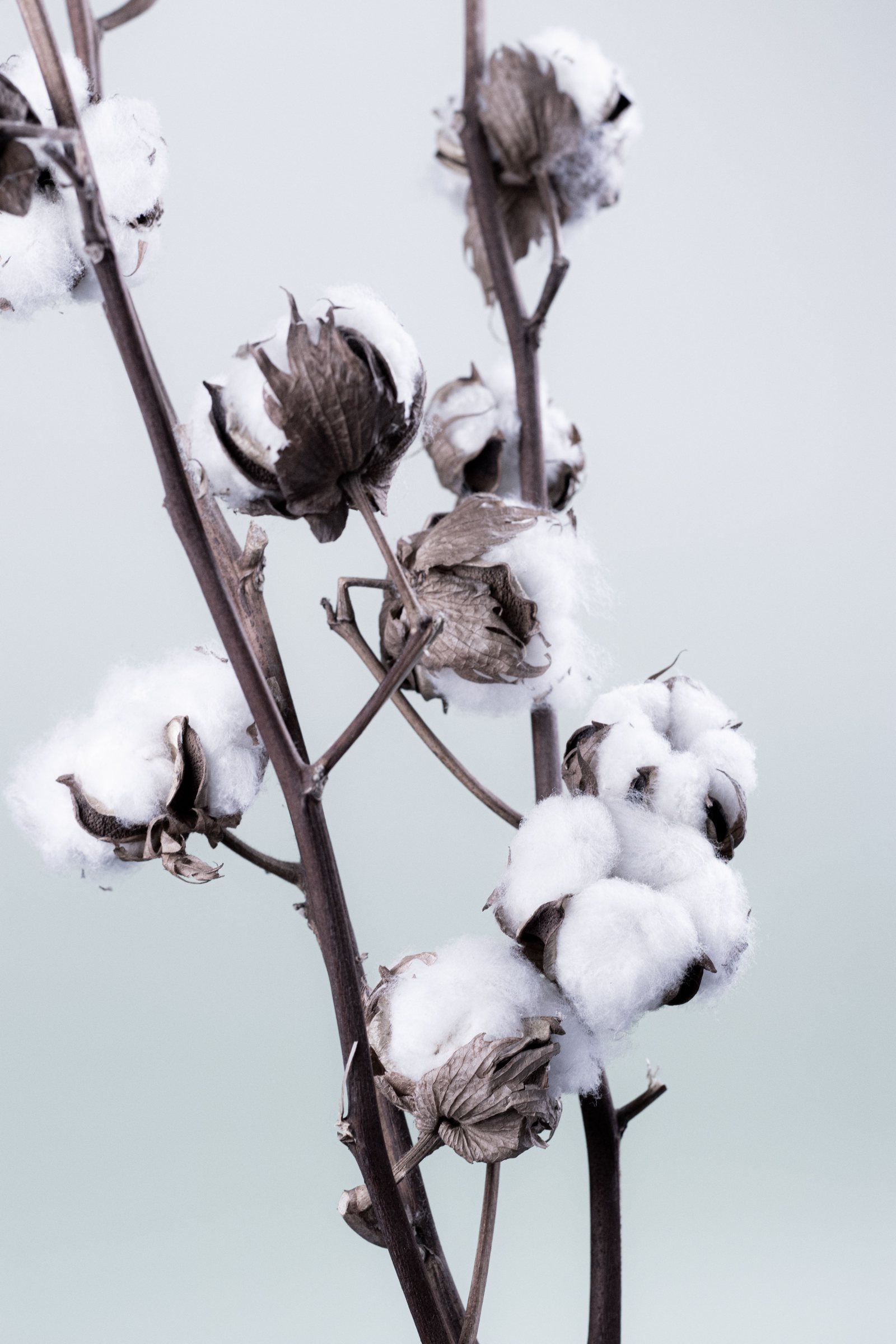
Cotton is the opposite fibre. It is hygroscopic: it takes water from the air and from the skin and lets it go again, which is why it is the summer cloth and the one to wear indoors with the heating on. The price of that is shrinkage. Cotton cloth relaxes when wet, and Cotton Incorporated's guide is blunt about the dryer: line or flat drying leaves only the elastic part of the shrinkage, while tumble drying realises all of it. Our cotton kurtis weigh 160 to 200 grams; wash them cool and let them dry on their own.
A British autumn in figures
Birmingham, monthly averages, 1991 to 2020
| Measure | SeptemberSep. | OctoberOct. | NovemberNov. |
|---|---|---|---|
| By day | 18° | 14° | 10° |
| By night | 10° | 7° | 4° |
| Days of rain | 10 | 12 | 13 |
| Days of frost | 0 | 1 | 4 |
| Hours of sun | 140 | 103 | 63 |
Met Office averages for Birmingham Winterbourne, 1991 to 2020, rounded. A day of rain is one with a millimetre or more; a day of frost is one with air frost.
Acro wool, in stock
Part three
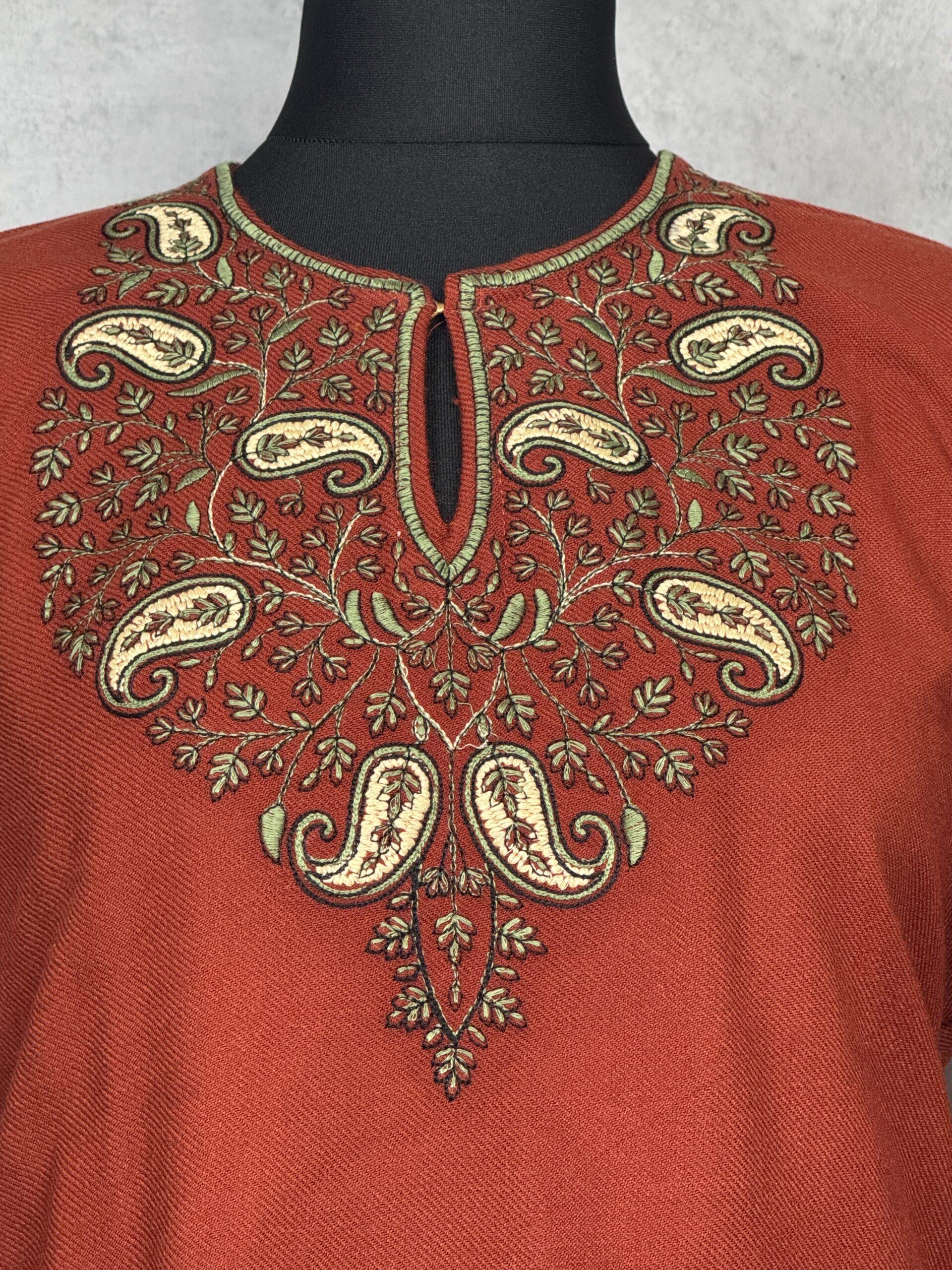
Two embroideries decorate a Kashmiri kurti. Aari is chain stitch worked with a hooked needle, fast enough to fill a whole yoke with flowers; tilla is gold or silver toned thread, once hammered metal and now a plated copper, laid at the neckline in paisley and vine. Both follow the pheran's rule of placement: the collar, the cuffs and the hem, the three places the eye lands when the rest of the garment is plain cloth. On a cotton kurti the neckline work is what you are paying for; on an acro wool one, the cloth and the work share the price.
The method is stated on each listing where we know it. Some of the acro wool kurtis carry hand needlework and say so; most of the cotton ones and many of the acro wool ones carry machine chain stitch, and say that. Where a listing says neither, ask us and we will check the piece before it ships. The finer, slower needle stitch of the heirloom shawls, sozni, does not appear on kurtis at these prices; our guide to sozni explains why it costs what it costs.
“What subtle threads the woman weaves, and makes them fine with love and reverence!”
Kabir, in Rabindranath Tagore’s translation, 1915

Cotton, in stock
Part four
South Asian dress has been part of British fashion for long enough that the V&A published a book on it, British Asian Style, in 2010. The kurti is the easiest of those cuts to wear; it asks nothing of the rest of the wardrobe: straight jeans or plain trousers, flat shoes, and the embroidery does the work. A Kashmiri weekly noted in February 2026 that the pheran is now draped over denim by celebrities and has become a winter uniform among students in Delhi; the kurti is the same idea at hip length, and a British-based retailer told Village Square in 2023 that his Kashmiri garment sales had gone from a handful to hundreds.
Here is how the two cloths fit the calendar above. In September the cotton kurti is the day's only layer. From October the acro wool one takes over, and it is warm enough on its own at 14 degrees; by November it goes under a coat, with the neckline showing.
| When | What works |
|---|---|
| At homethe evening, the weekend | A cotton kurti over leggings or soft trousers, whatever the heating is doing. The cloth breathes; the neckline still looks dressed if someone calls.Nargis, Gulaal |
| Out, over jeansOctober, 14 degrees | An acro wool kurti with straight jeans and a flat boot. Dark grounds and rust hide the weather; the paisley at the neck is the point.Ruhani, Midnight Fern |
| The officeand the school run | Navy or dark green acro wool, plain trousers, a scarf in the same family of colour. Nothing to iron in the morning.Azurevine, Roselace Heirloom |
| An eveningDiwali on 8 November, Eid, a dinner | Tilla at the neckline, in a jewel colour. The gold thread is made for lamplight, and cotton in a warm room is the right weight.Sosan Aasmaan, Shehzadi |
Part five
Acro wool takes the wool cycle: the two-bar washtub on the care label, which the label system defines as a very mild wash at 30 or 40 degrees with the drum no more than a third full, or a hand wash in lukewarm water. Turn embroidered pieces inside out first so the thread does not rub. Then dry it flat: acrylic hung wet will stretch, and it must not go in the tumble dryer or under a hot iron; a little steam on the wool setting is all it needs. Cotton is simpler and less forgiving of the dryer. Wash it cool, dry it on the line or flat, and iron it hot while it is still slightly damp.
Prices run from £15 to £25. UK delivery is £4.95 and takes three to five working days, free from £60, which two kurtis and a scarf will usually reach. Unworn pieces with their tags can be returned within fourteen days.
Questions, answered
A short tunic worn by women in South Asia, the shorter and closer-fitting form of the kurta, worn over trousers or jeans. A Kashmiri kurti carries aari or tilla embroidery at the neckline, cuffs and hem.
Length and cut. A kurta is the long, loose shirt worn by men and women, often to the knee or below; a kurti stops at the hip or the top of the thigh and is cut closer.
Each is one size, cut loose. The cotton kurtis run 27 to 30 inches long and about 21 to 22 inches across the chest laid flat; the listing gives the figures where we have measured them.
Warm enough for a British October on its own and for November under a coat. It is a blend of wool and acrylic: lighter and quicker to dry than pure wool, and it pills sooner. For a winter of hard wear, our pherans in pure wool are the step up.
Acro wool: yes, on the wool cycle at 30 or 40 with a mild detergent, inside out, then dried flat. Cotton: a cool wash, then line or flat dry; the tumble dryer is what shrinks it.
Some acro wool kurtis carry hand needlework and their listings say so; most cotton kurtis, and many acro wool ones, carry machine chain stitch and say that. Where a listing says neither, ask us and we will check the piece.
Sources: John T. Platts, A Dictionary of Urdu, Classical Hindi, and English (1884), p. 824; F. Steingass, A Comprehensive Persian-English Dictionary (1892), p. 1021; Yule and Burnell, Hobson-Jobson (1903), p. 113; the V&A collection, IS.14-2008 and IS 3-1997, and British Asian Style (2010); Upendra Kaul in Greater Kashmir, 2021 and 2024; Kashmir Life, February 2026; Village Square, 2023; Asia InCH on tilla; Rosa, Rosace and Trovato, Polymers, 2024; the Drycleaning and Laundry Institute on acrylic; NIST CS11-41 on cotton regain; Cotton Incorporated, Guide to Improved Shrinkage Performance; GINETEX care symbols; Woolmark on the wool cycle; Met Office climate averages, Birmingham; Walter R. Lawrence, The Valley of Kashmir (1895); Songs of Kabir, translated by Rabindranath Tagore (1915), poem XCII.
PHOTOGRAPHY BY Kashmir Bloom; the garden by Imad Clicks and the cotton by Andréa Devillier, on Pexels