Your bag is empty
Add something beautiful to get started
The Winter Edit
Don but such apparel as will cause the cold to flee.
Eat but so much food as will cause hunger to cease.
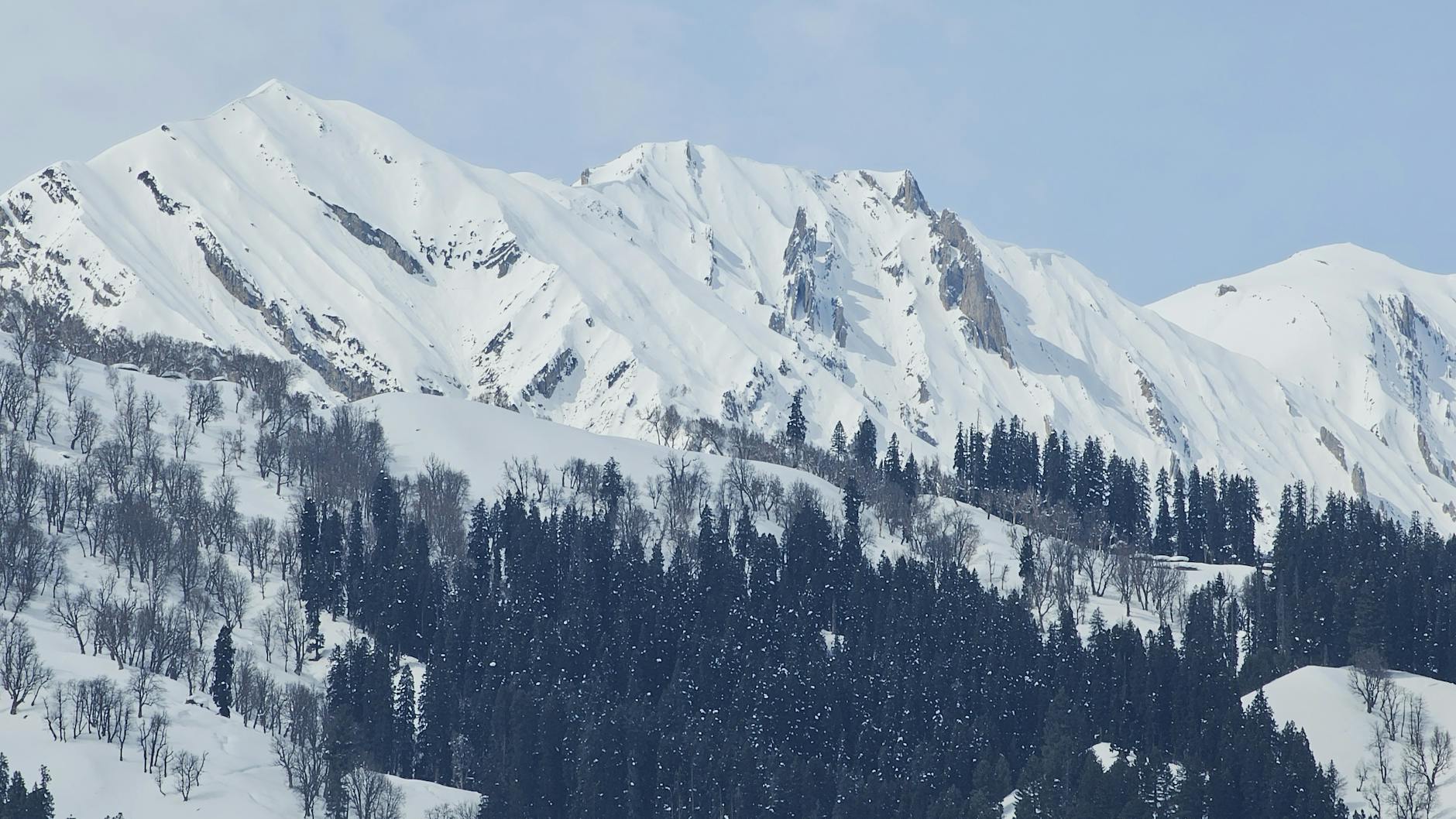
Snow on a Himalayan ridge. In Kashmir the deepest cold has a name, Chillai Kalan, the forty days from 21 December, and the pheran was cut for it.
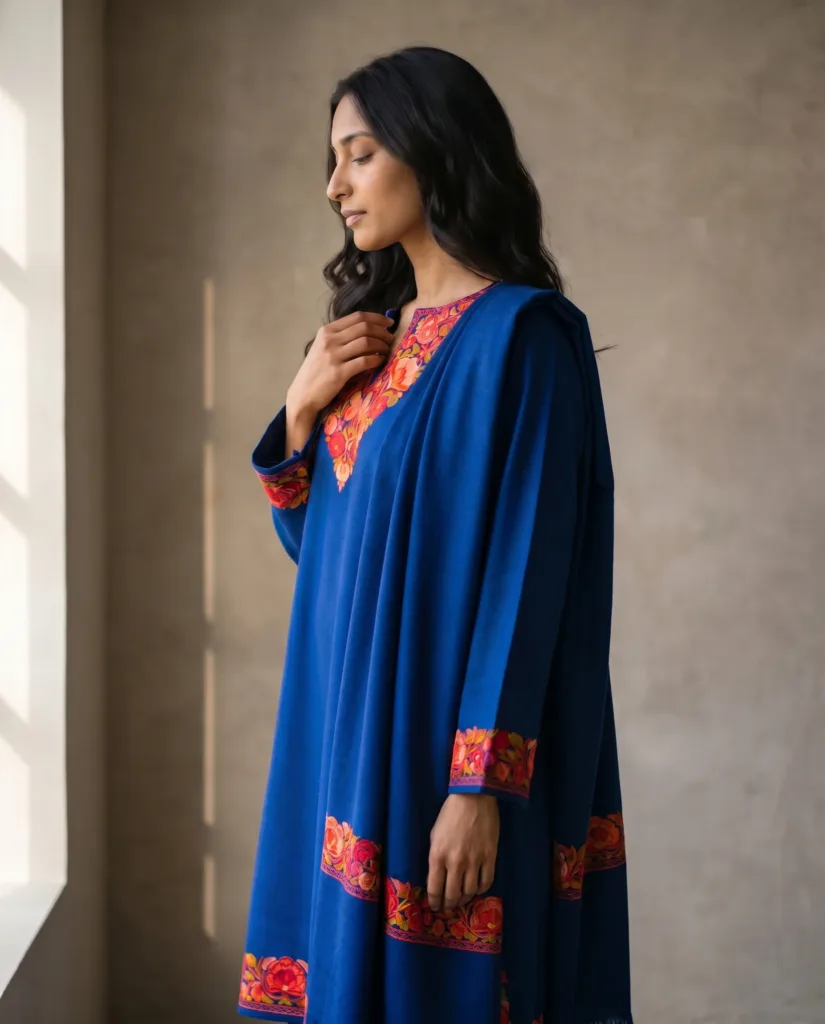
A pheran is the long, loose over-garment Kashmiris have worn through winter for centuries. It buttons at the neck, falls below the knee, and is cut wide on purpose: wide enough to hold the warmth of a kangri, the wicker-cased pot of embers carried underneath it. This guide covers where the pheran comes from, what ours are made of, the three embroideries that decorate them, and how to wear one in a British winter.
That winter is milder than Kashmir’s but wetter. Birmingham’s December, January and February run at about 7 degrees by day and 2 at night, with rain on eleven to thirteen days a month, on the Met Office averages. A pheran is not a coat for that weather. It is the garment for the other twenty hours of the day, indoors, over one thin layer, in a house where the heating goes off at night.
Part one
The word comes from the Persian perahan, a shirt or cloak, and the garment’s age is argued over. Some historians trace it to robes brought by Persian and Central Asian Sufis in the fourteenth and fifteenth centuries; others point to earlier gowns in the valley; a popular story credits the Mughal emperor Akbar after 1586. Walter Lawrence, the British settlement officer who wrote The Valley of Kashmir in 1895, was already reporting the Akbar story as a patriotic claim rather than a fact.
Lawrence’s description of the cut still holds. The pheran was heavy and full, buttoned at the neck, and fell to the feet with a deep hem; it was wool in winter and cotton in summer, with sleeves wide and loose and the cuffs turned back. Today’s pherans stop below the knee. A woman’s pheran runs slightly shorter than a man’s and carries its embroidery at the collar, the cuffs and the hem, and the traditional way to wear one is over a second, lighter gown, the pochh, in cotton.
“In the winter, and even in the summer when rains chill the air, hot embers are put into the kangar and it is slipped under the voluminous gown which all Kashmiris wear.”
Walter Lawrence, The Valley of Kashmir, 1895
The kangri Lawrence describes is an earthenware bowl in a wicker frame, filled with embers and held against the body under the pheran. It is why the garment is cut so wide. The pairing matters most in Chillai Kalan, the name Kashmir gives its deepest cold: chil is Persian for forty and kalan for major, and it begins on 21 December and runs about forty days. An average January in Srinagar goes from about 7 degrees by day to minus 2 at night, and on 21 December 2024 the city recorded minus 8.5, its coldest December night in fifty years. Since 2021, 21 December has also been marked in Srinagar as Pheran Day, with the handicrafts department behind the 2025 event.
Two winters in figures
Average day and night temperatures, and days of rain
| City and measure | DecemberDec. | JanuaryJan. | FebruaryFeb. |
|---|---|---|---|
| Birmingham | |||
| By day | 7° | 7° | 8° |
| By night | 2° | 2° | 2° |
| Days of rain | 13 | 13 | 11 |
| Srinagar | |||
| By day | 10° | 7° | 11° |
| By night | −2° | −2° | 1° |
Met Office averages for Birmingham Winterbourne, 1991 to 2020; Indian Meteorological Department normals for Srinagar over the same years. Rounded to the degree. A day of rain is one with a millimetre or more.
Part two
The classic pheran cloth is raffal, a merino wool of 19 to 21 microns woven in Punjab and named, the Australian wool industry’s own body records, after the merino shawls Kashmir made famous. Tweed, called pattu in the valley, makes a firmer, coat-like pheran; hand-spun tweed costs roughly two and a half times the mill-made kind. Velvet is the occasion cloth, and cotton the summer one, as it was in Lawrence’s day.
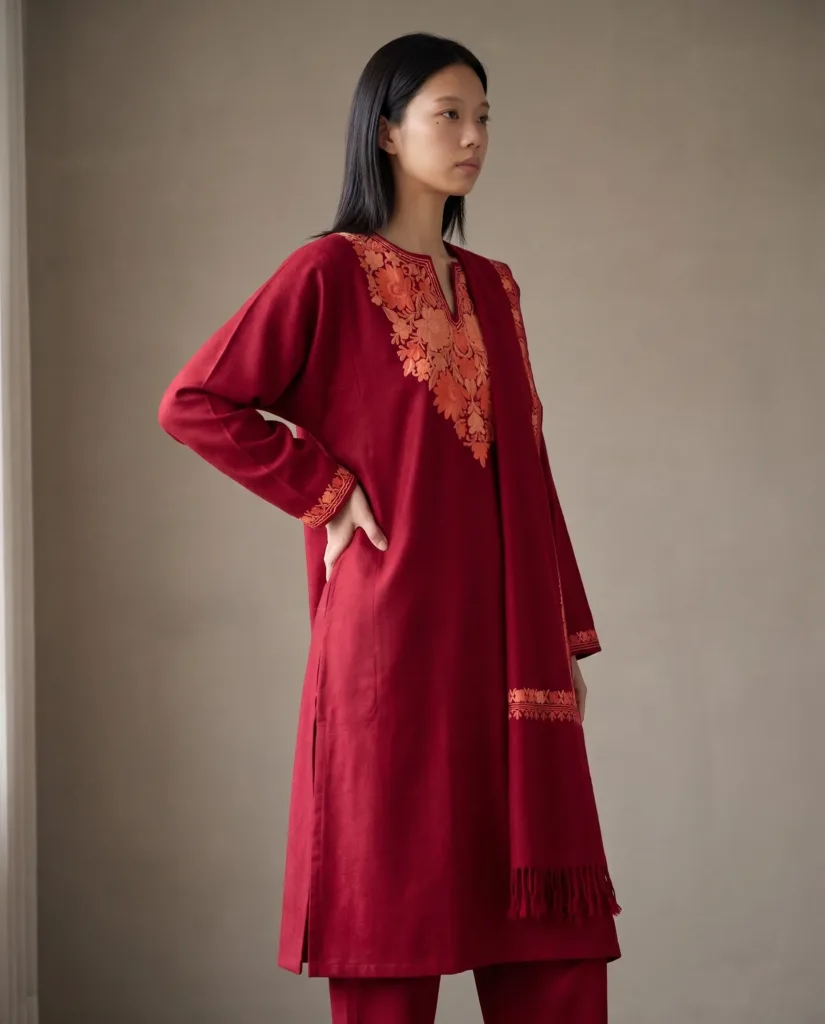
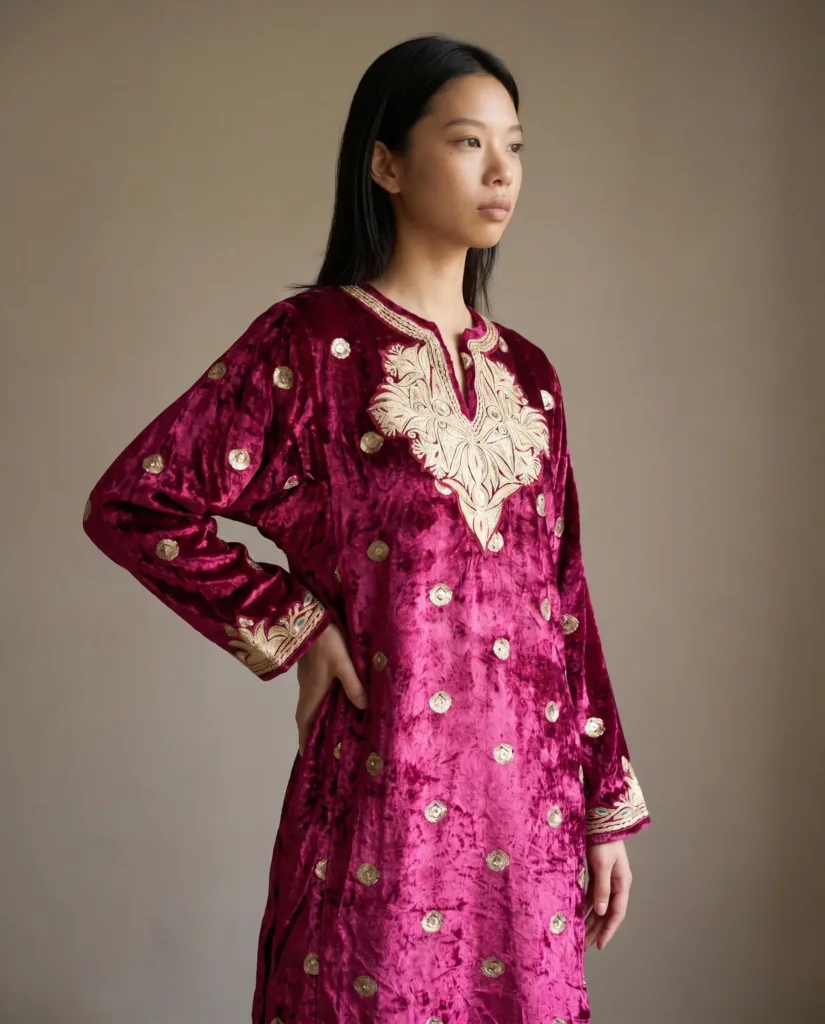
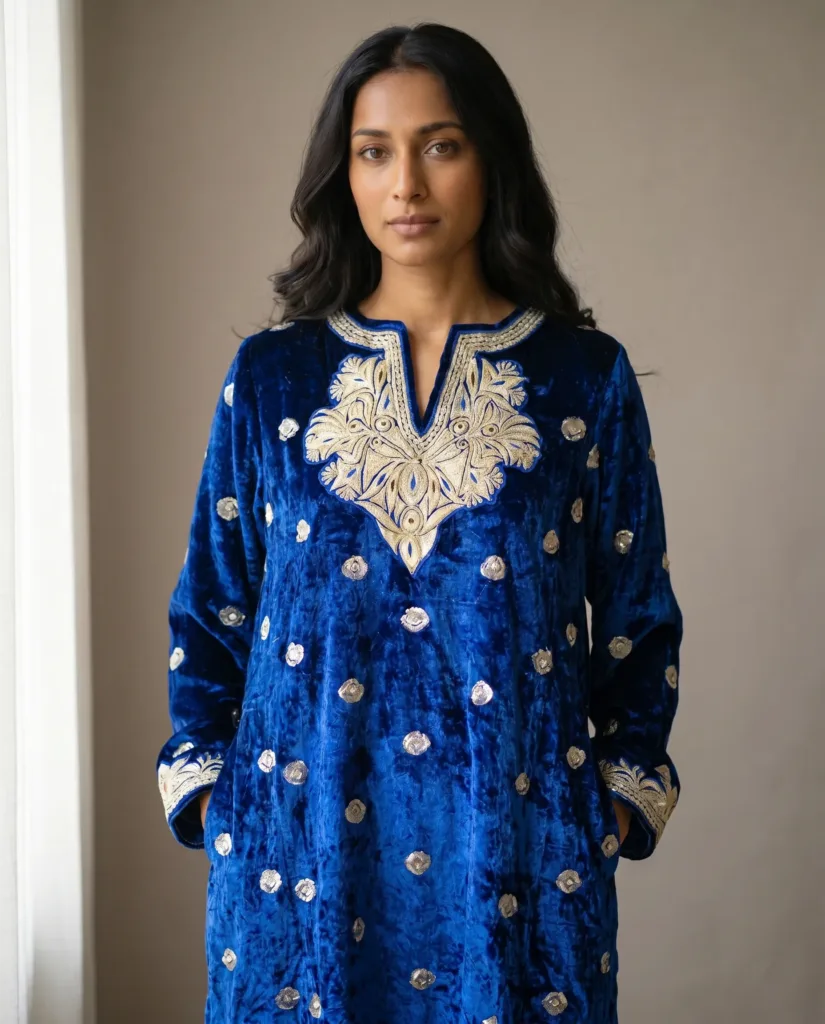
Our range holds 80 pherans, 65 of them in stock today, from £25 to £80. Most are acro wool, a wool and acrylic blend that is light, warm and easy to care for, though it takes up less moisture than pure wool and pills sooner. Ten are 100 per cent wool at £80, the ones to choose if the pheran will be worn hard all winter. Two are velvet sets at £70, machine-woven velvet with satin, and at 750 grams they are the heaviest pieces we sell. A set means the pheran, a matching scarf and trousers. Every pheran is cut loose, in one size, to go over a layer.
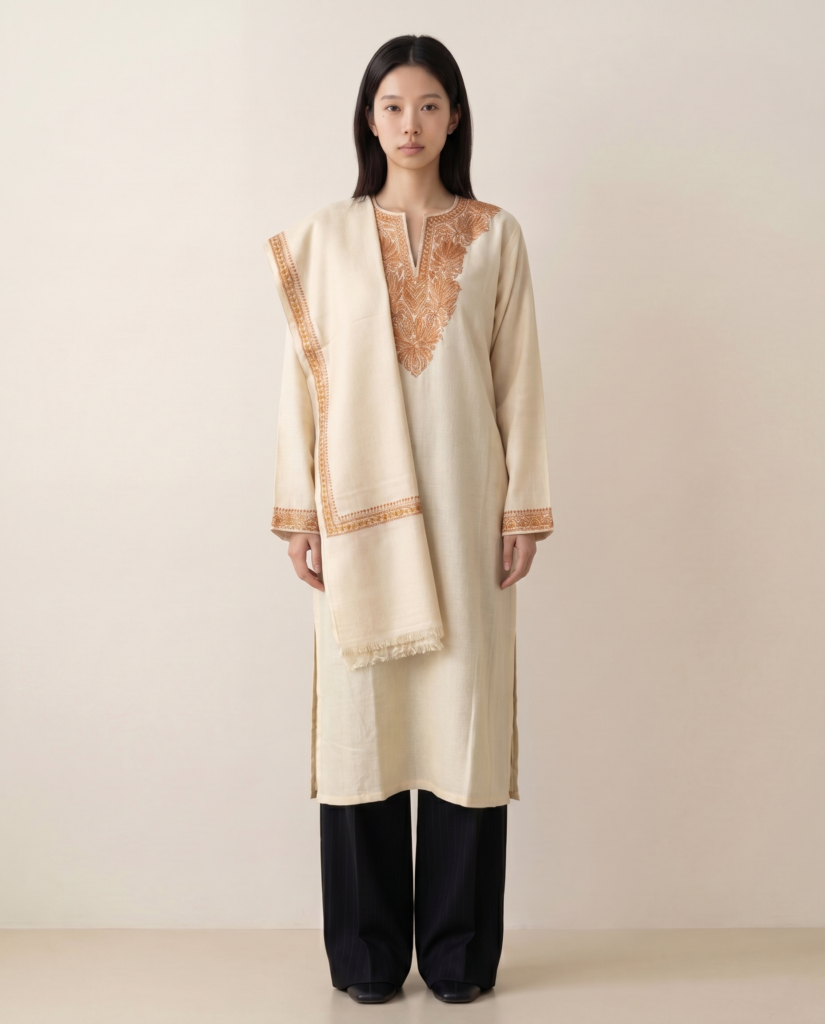
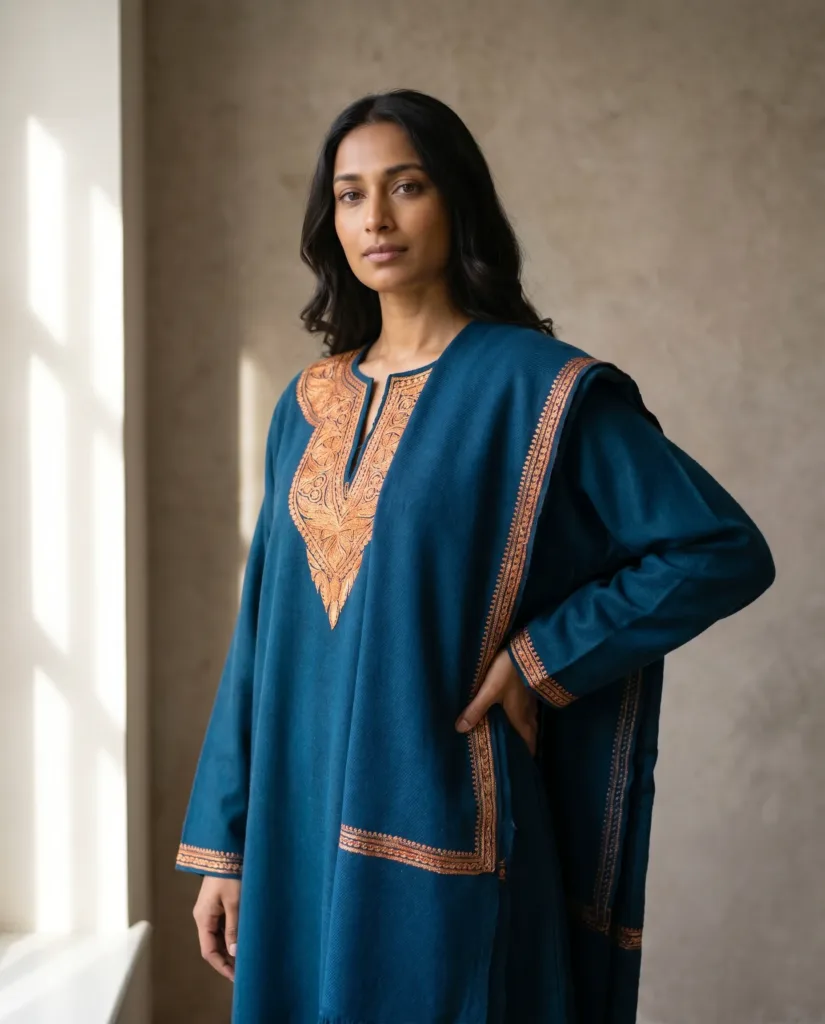
Aari and wool, in stock
Part three
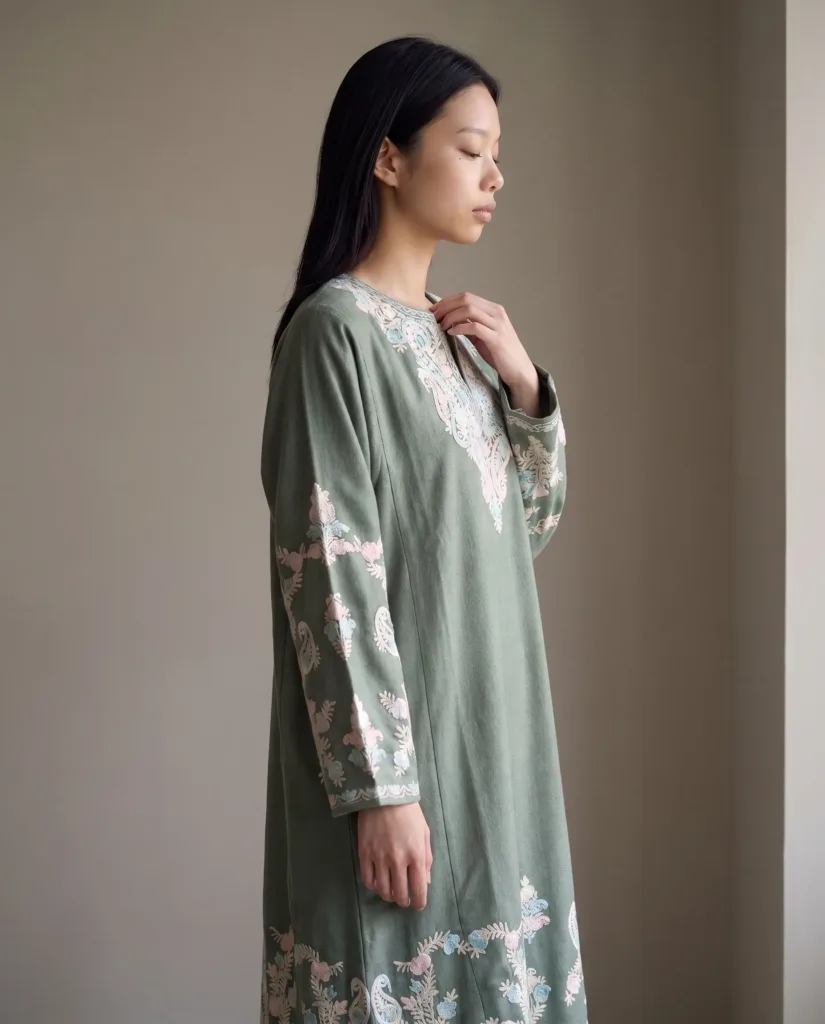
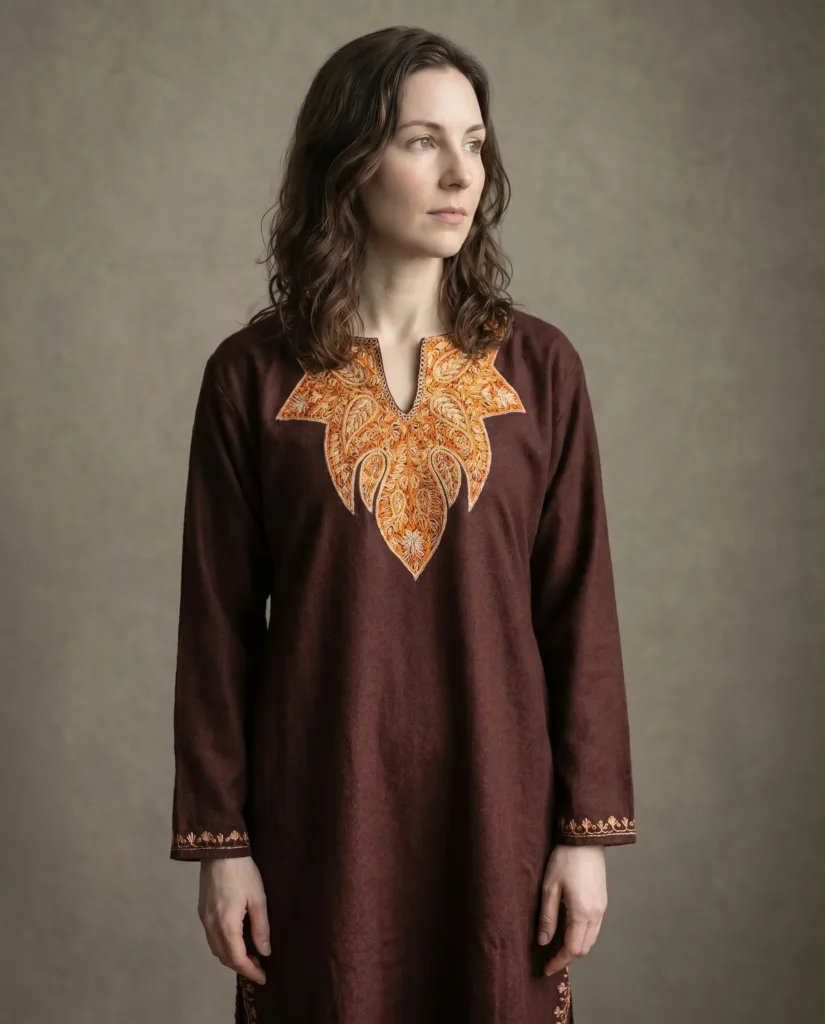
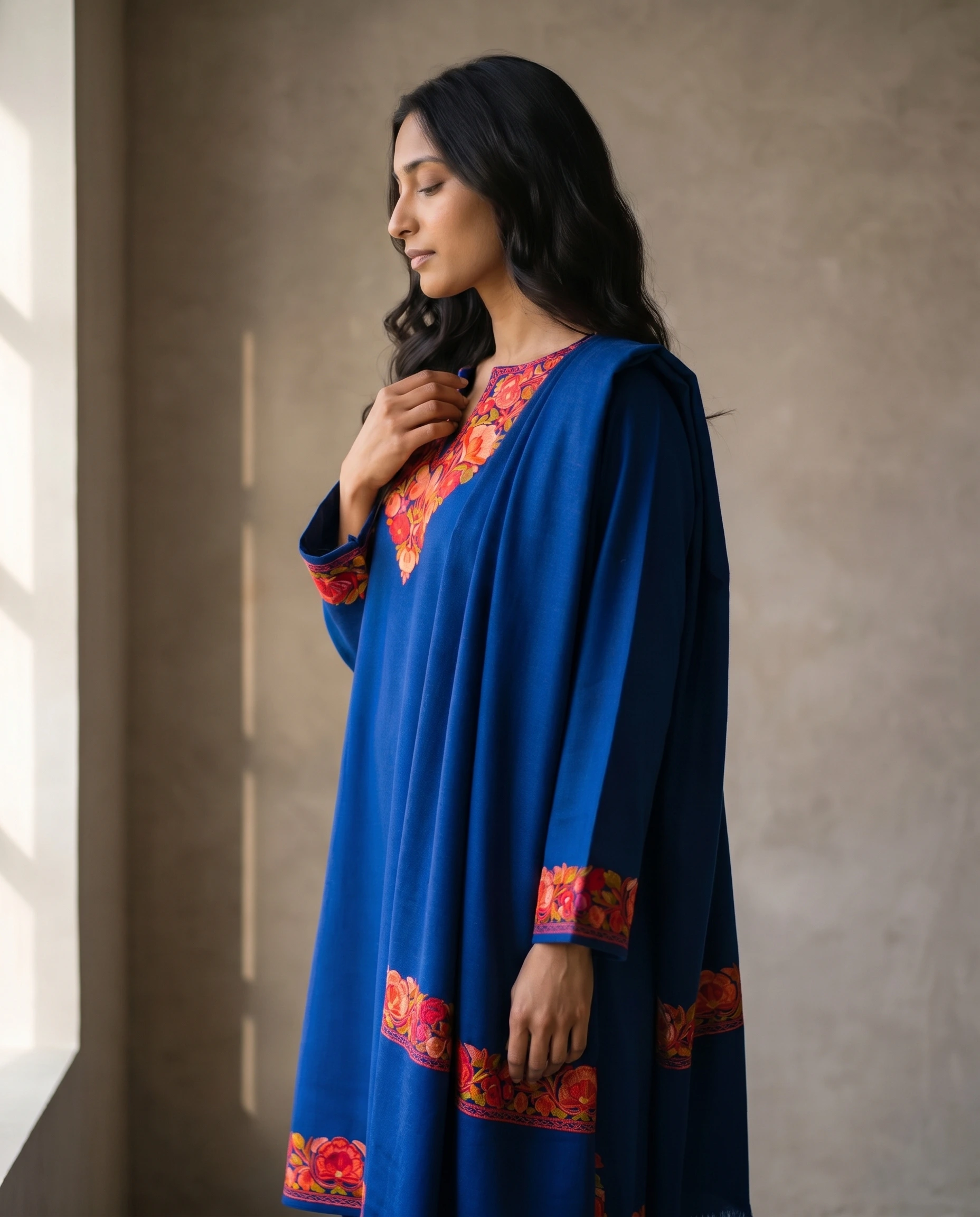
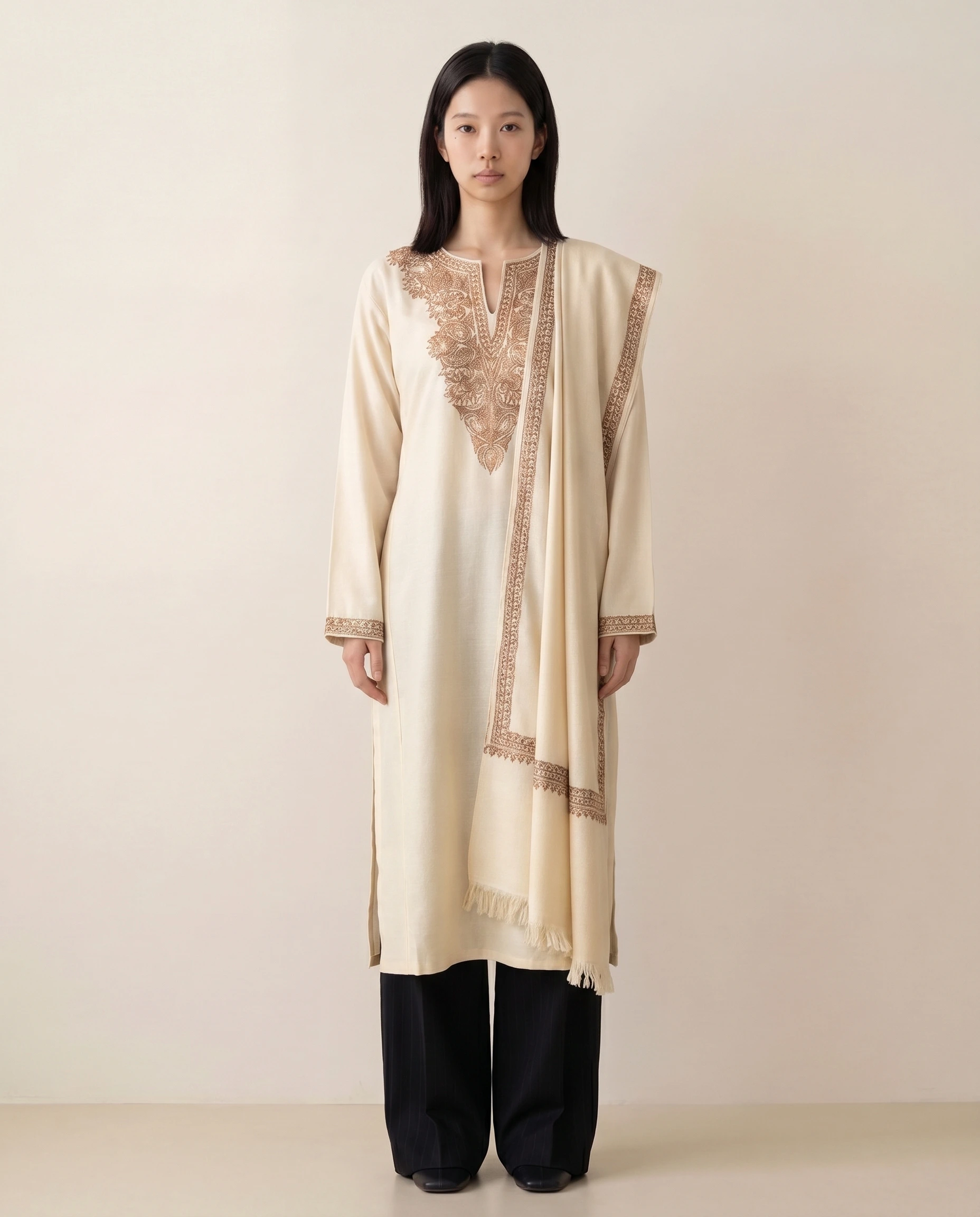
Three embroideries decorate a pheran, and the name on the product tells you which. Aari, also called zalakdozi, is worked with a hooked needle from beneath the cloth, each pull drawing a chain of loops through the last; it moves fast, which is why it can cover a whole yoke and hem with flowers. Forty-four of our pherans carry it. Tilla is gold or silver thread, once hammered metal and now a plated copper thread, laid at the neckline in paisley and vine; thirteen pieces carry it, mostly on ivory and teal grounds. Sozni is the fine needle stitch of the heirloom shawls, worked so evenly that many pieces read the same on both faces; it appears on one pheran here, and our guide to sozni explains the hours it takes.
Where the work sits tells you something too. Embroidery at the collar, cuffs and hem is the traditional women’s placement, and it is where the eye lands when the pheran is worn over plain trousers.
Tilla and velvet, in stock
Part four
A pheran replaces the cardigan and the dressing gown at once. Indoors it goes over a thin knit or a shirt and stays on all day; the loose cut means it never feels like a layer you are waiting to take off. Outdoors, in the British cold, it goes under a coat rather than instead of one, and the hem shows below.
| When | What works |
|---|---|
| At homethe evening, the weekend | An acro wool pheran over a thin knit, with the house at whatever it is. This is the garment’s real job.Zaheen Chestnut, Bahar e Noor |
| Out, over jeansthe school run, the shops | A plain or lightly embroidered pheran under an open coat, hem below the coat. Dark grounds hide the weather.Zarif, Gulzar-e-Kabood |
| An eveningEid, Diwali, a family dinner | Tilla or velvet, with the set’s matching scarf. The gold thread is made for lamplight.Hunar-e-Ivory, Gulzar-e-Zar |
| The cold snap2 by night, and a day when it stays there | Pure wool, worn as the Kashmiris wear it: over a second thin layer, with a hot drink where the kangri would be.Surkh-e-Gulnaar, Shehzadi Zareen |
Part five
Acro wool and wool pherans want the same care as a wool scarf: hand wash in cool water with a wool detergent or use a wool cycle, press the water out in a towel, dry flat, and fold rather than hang so the shoulders do not stretch. Turn an embroidered pheran inside out before washing so the thread does not rub, and keep tilla away from anything that catches, since the metal thread will pull. Velvet is dry clean only; never iron the pile.
Prices run from £25 to £80, and the sets at £60 and £70 include the scarf and trousers. Free UK delivery starts at £60, so every set ships free and arrives in three to five working days. Unworn pieces with their tags can be returned within fourteen days.
Questions, answered
A long, loose Kashmiri over-garment, buttoned at the neck and falling below the knee, worn through winter over a lighter layer. The wide cut leaves room for a kangri, the pot of embers carried underneath.
Every pheran we sell is one size and cut loose, so it goes over a knit or a shirt. The fit is meant to be roomy; it is not a fitted dress.
The pherans in our range are the women’s cut, with the embroidery at the collar, cuffs and hem. The traditional men’s pheran is longer and plainer.
Aari is chain-stitch embroidery worked with a hooked needle in coloured thread, and it can cover a whole yoke. Tilla is gold or silver thread, now a plated copper thread, laid in paisley and vine at the neckline. Sozni is the finer needle stitch of the heirloom shawls.
Yes. Hand wash in cool water with a wool detergent, or use a wool cycle, then dry flat. Turn embroidered pieces inside out first. Velvet pherans are dry clean only.
The forty-day heart of the Kashmiri winter, beginning on 21 December. The name is Persian for the major forty. It is when the pheran and the kangri earn their keep, and 21 December has been marked as Pheran Day in Srinagar since 2021.
Sources: Walter R. Lawrence, The Valley of Kashmir (1895), pages 250 to 251; C. E. Tyndale Biscoe, Kashmir in Sunlight and Shade (1922); Lalla-Vakyani, translated by George Grierson (1920), verse 28; Met Office climate averages, Birmingham; Indian Meteorological Department normals for Srinagar; The Tribune on the December 2024 cold; Kashmir Life on Pheran Day; Australian Wool Innovation on raffal; Kashmir Life on pheran cloth; Asia InCH on aari, tilla and sozni; Cogent Arts and Humanities, 2025, on the pheran and the pochh.
PHOTOGRAPHY BY Kashmir Bloom; the mountains by Shahid Sultan on Pexels