Your bag is empty
Add something beautiful to get started
The hook work of Kashmir
She uses not a needle but a thorn of the wild rose.
The needle is made by man, the thorn by God.
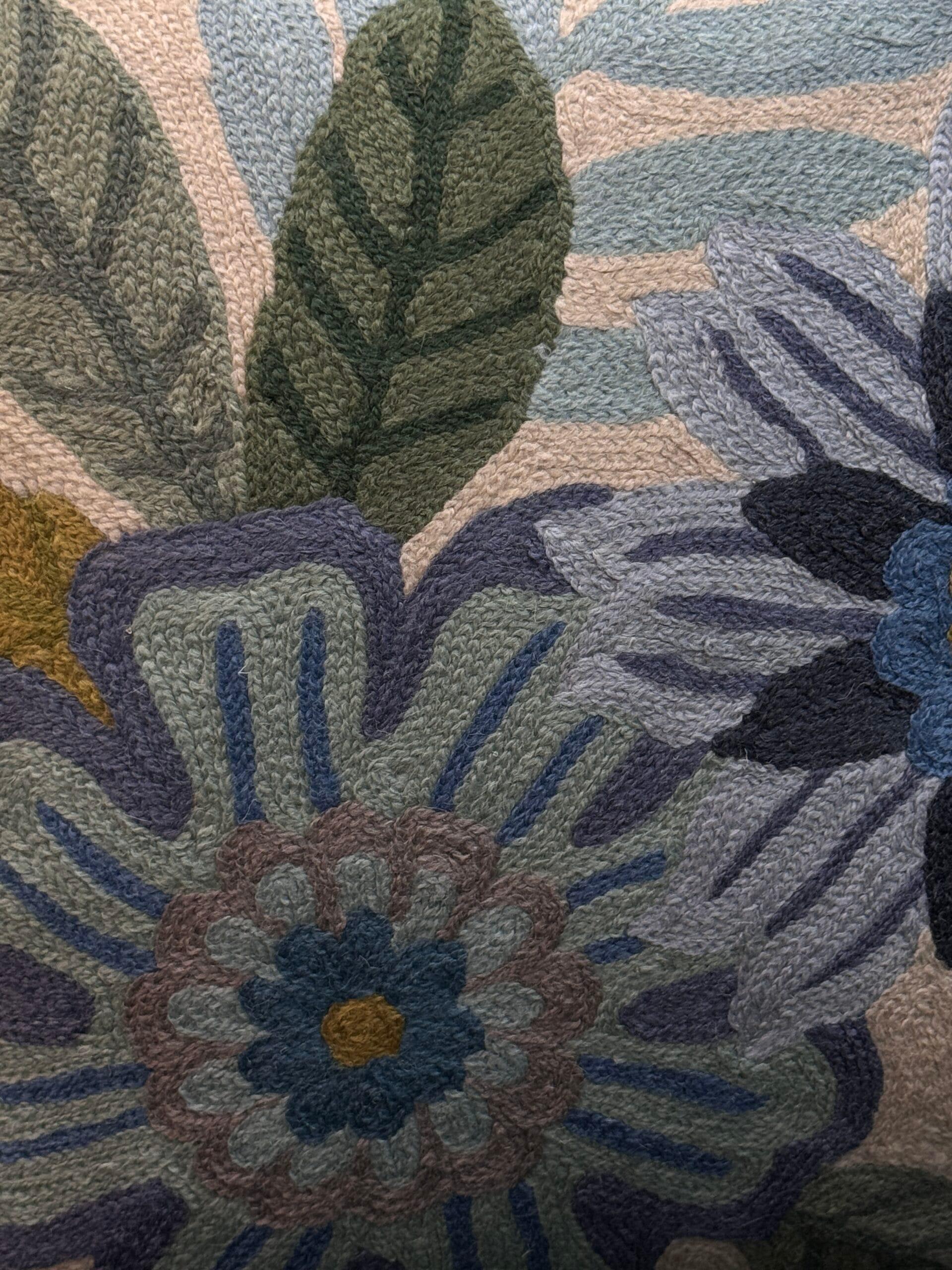
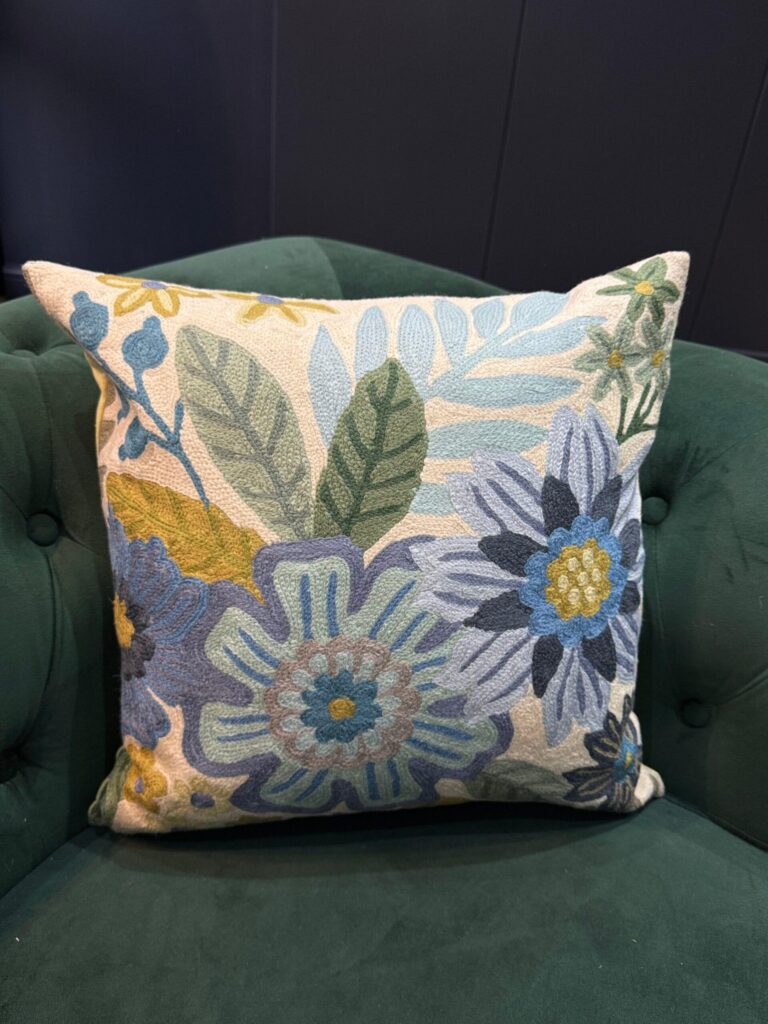
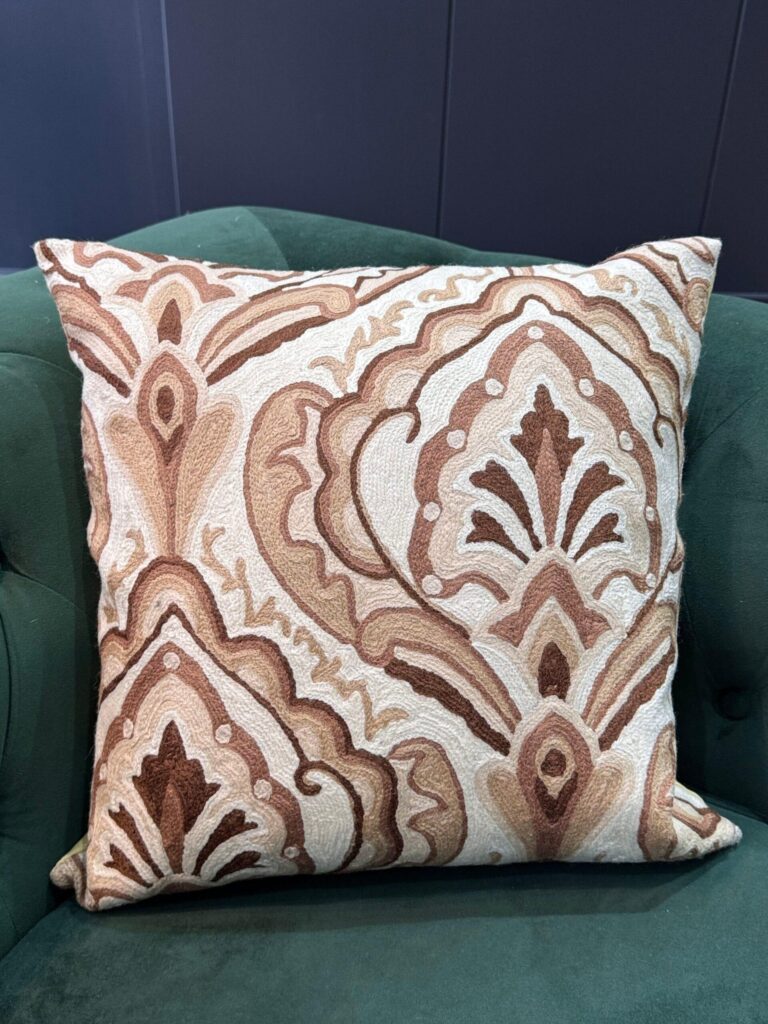
Chain stitch on wool, close to: the Gul-e-Aab cushion cover, worked by hand with a hook, £40.
Aari is the hook embroidery of Kashmir. The tool is a long, fine needle that ends in a hook, set in a wooden handle, and the stitch it makes is a chain, each loop drawn up through the one before. Because the hook pulls a loop with every dip, it covers cloth far faster than a needle can, which is why aari is the embroidery of whole fields of flowers: the yoke of a pheran, the front of a kurti, a cushion cover worked edge to edge. Kashmiris also call it zalakdozi, and the same stitch in wool thread on furnishings is what the trade calls crewel.
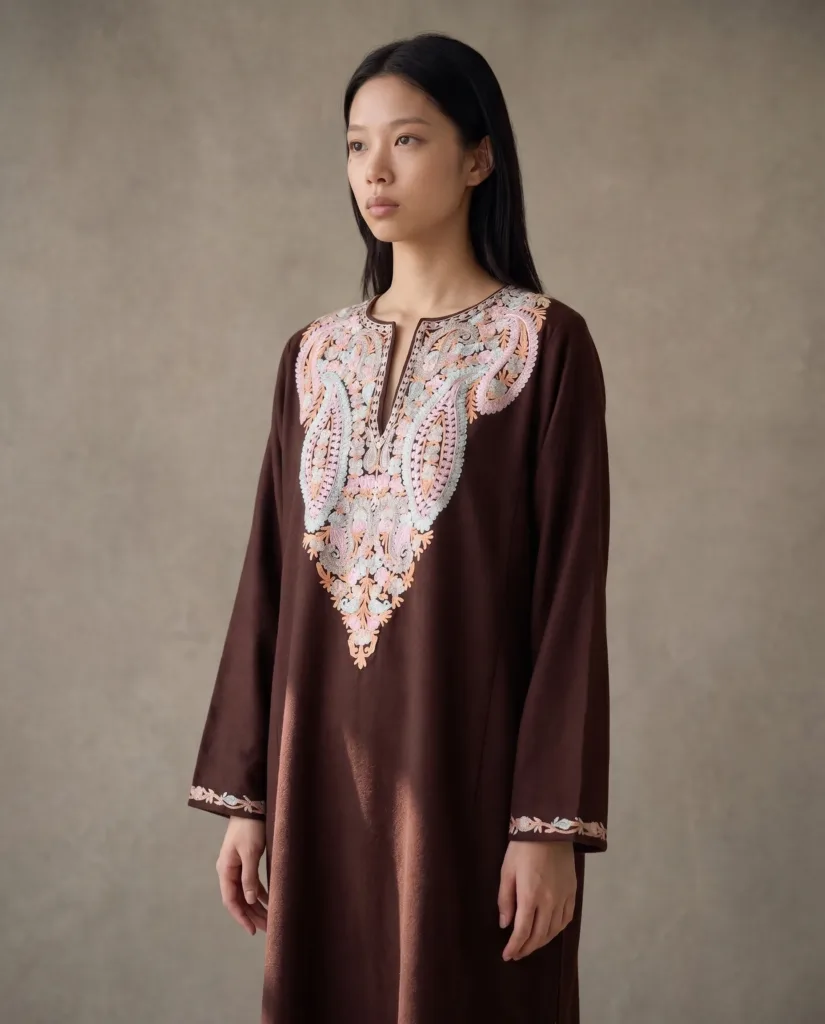
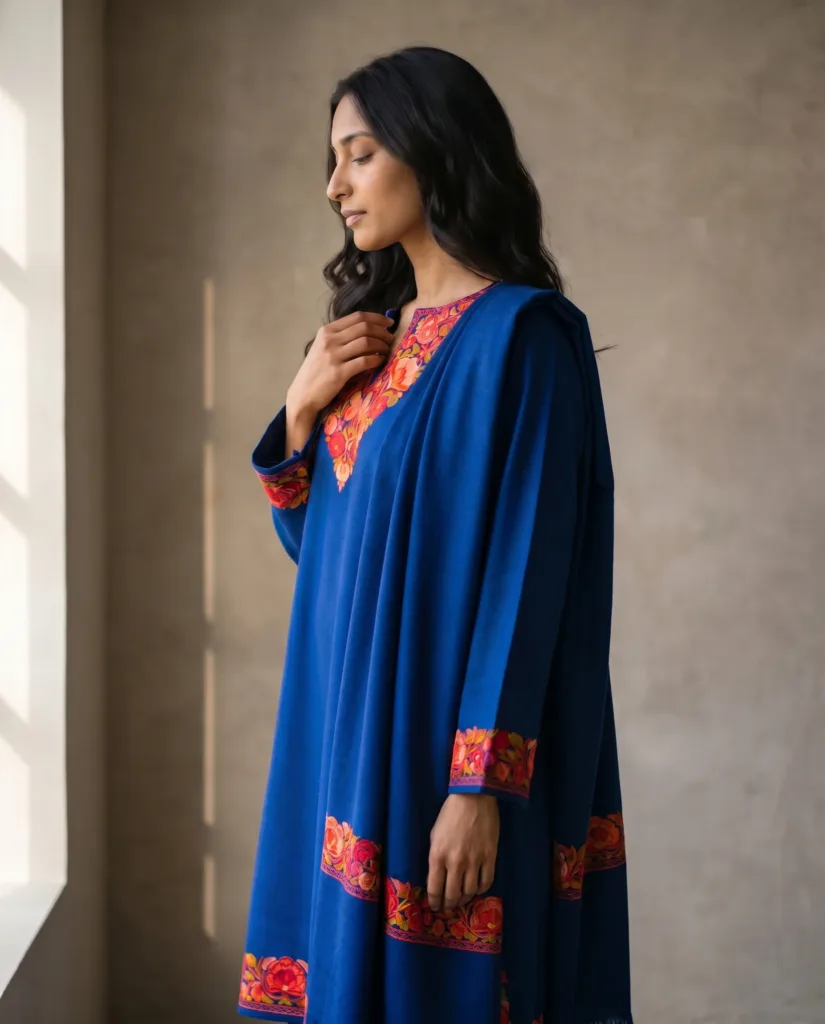
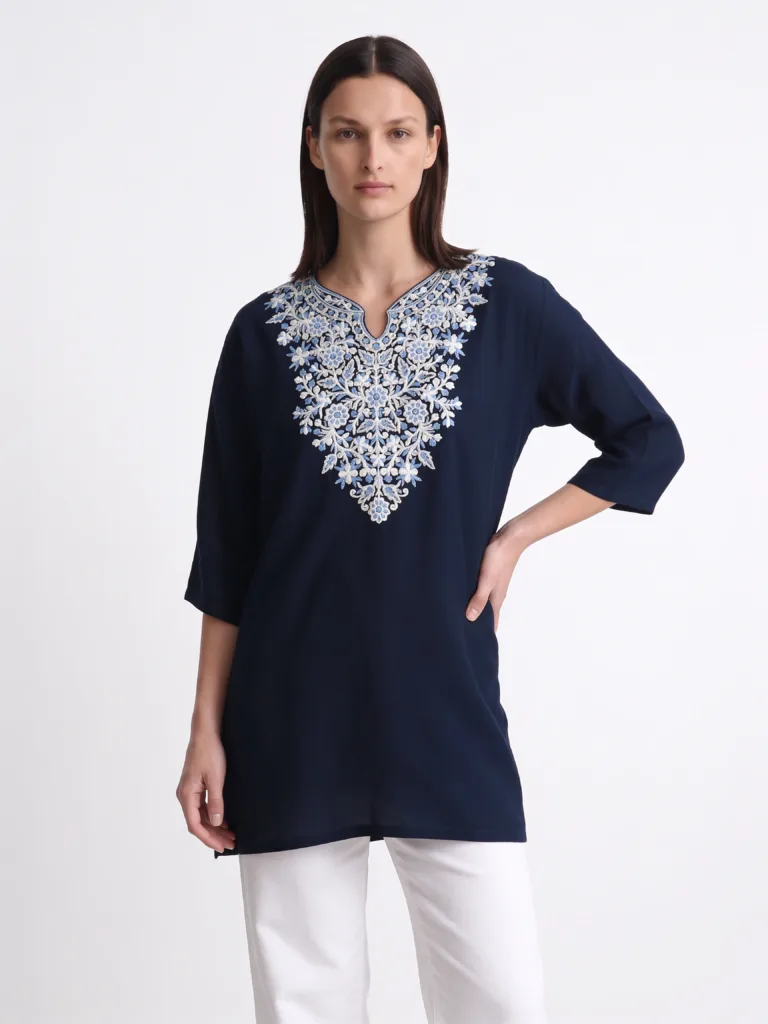
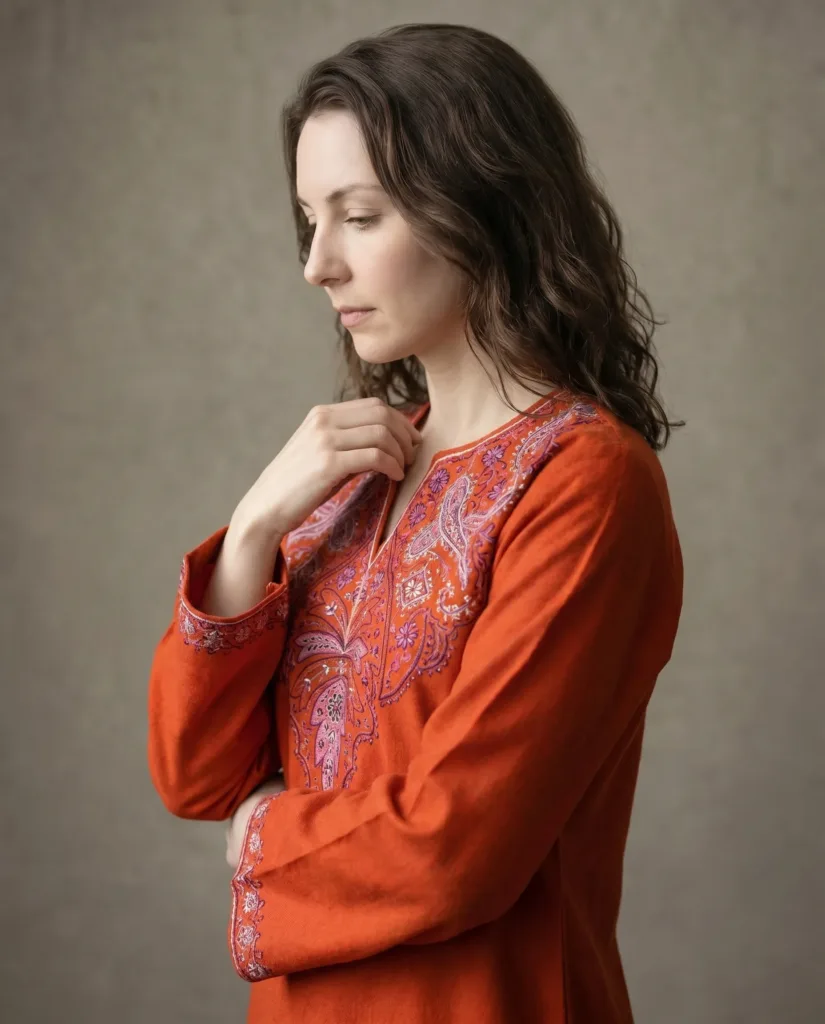
We sell 182 pieces with aari, 150 in stock today, from £15 for a cotton kurti to £165 for a pure wool jacket. The method is not the same across the range. The wool cushion covers and the woollen jackets are worked by hand, and their listings say so; the wool silk scarves and most of the cotton kurtis and kaftans carry machine chain stitch, and say that. Where a listing says neither, ask us and we will check the piece before it ships. Below: how the hook is worked, where it came from, how to tell it from sozni and from the machine, and how to wash it.
Part one
The cloth is stretched drum tight on a frame. The embroiderer holds the hook above it and feeds the thread from below with the other hand; the hook goes down through the cloth, catches the thread and brings it back up as a small loop, and the next dip goes through that loop. The line it leaves sits slightly raised, like a fine cord, and a flower is filled by running the line round and round in concentric rings.
The design comes first, and it is someone else's job. A naqash draws it. A tracer, the naqashband, pricks the drawing through paper, lays the paper on the cloth and rubs charcoal or chalk through the holes, then joins the dots with a pen. William Moorcroft watched the same pounce method in Srinagar in the 1820s, down to the gum arabic that fixed the powder. The hook itself is often made in the workshop, a steel rod turned and set in a handle, and a little mustard oil on the index finger keeps it moving. The thread was wool, silk or cotton; wool and cotton remain, and rayon has replaced most of the silk. Within the craft it is said to take sixteen years to master.
“To the public generally the chain stitch of Kashmir is more prominently associated with embroidered felts (namdas) and woollen curtains, than with shawls.”
George Watt, Indian Art at Delhi, 1903
Part two
Nobody can date it. The hook is credited variously to craftsmen from Damascus under Sultan Zain-ul-Abidin in the fifteenth century and to Persian Sufis and their followers; the Victoria and Albert Museum notes that hook embroidery in India most likely began with the Mochi shoemakers, on leather before cloth. What the record shows is the market. The Kashmir shawl was woven work, slow and dear, and the early nineteenth century found a cheaper route: shawls embroidered by needle on plain cloth, which Walter Lawrence in 1895 called amlikar and said never fetched more than 200 rupees against the loom-woven kind. The story usually told is that an Armenian merchant, Khwaja Yusuf, began it in 1803 and that five thousand embroiderers were at work within twenty years.
Then the trade fell, with the war between France and Germany in 1870 and the famine of 1877 to 1879: a French merchant told Lawrence that Srinagar's thirty or forty thousand weavers were down to four thousand. The hands went into carpets and into chain stitch on felts and curtains, and by 1903 George Watt was recording a large new export trade in exactly that. It never left. Tyndale Biscoe found Anantnag in 1922 living on embroidery and on curtains made from old blankets, and the handicrafts register to March 2025 still puts ten of Kashmir's thirteen thousand chain-stitch artisans there.
Recognition came late. UNESCO named Srinagar a Creative City of Crafts and Folk Art in 2021, with ari among the seven city crafts in the dossier. In January 2023 the handicrafts department filed for Geographical Indication marks on Kashmir Chain Stitch and Kashmir Crewel, registered in 2025. There is no mark called aari; the hook is covered by those two, and an aari and staple embroidery application is next.
The needle trades in figures
Artisans registered with the Kashmir handicrafts department, 31 March 2025
| Craft | Artisans | Share |
|---|---|---|
| Sozni | 123,603 | 32% |
| Crewel | 48,629 | 13% |
| Staple embroidery | 13,827 | 4% |
| Chain stitch | 13,014 | 3% |
| All sixty crafts | ||
| Registered artisans and weavers | 381,505 | 100% |
Department of Handicrafts and Handloom, Kashmir, in reply to a right-to-information request, as reported by Greater Kashmir, August 2025. Share is of all registered artisans; the register does not separate hook work from needle work within crewel.
Worked by hand, in stock
Part three
Three things get called Kashmiri embroidery, and they are easy to separate once seen side by side. Sozni is needle work: tiny flat stitches on the surface of fine cloth, often so even that a shawl reads the same on both faces, and slow enough that some pieces take years; it has carried a Geographical Indication filing as Kashmir Sozani Craft since 2006, and our guide to sozni covers it. Tilla is metal thread, gold or silver toned, laid at a neckline. Aari is the chain: raised, linear, quick, and at home on wool.
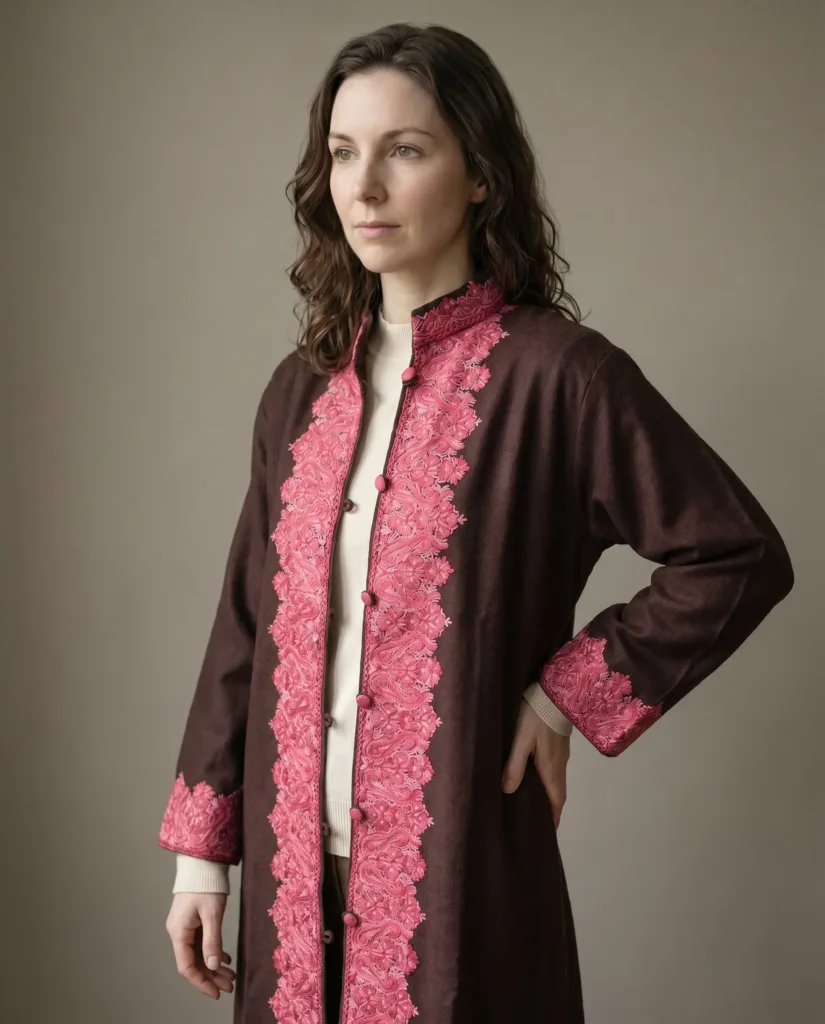
Machine chain stitch exists, and it is honest work at its price: the wool silk scarves at £55 to £65 and most of the cotton kurtis at £15 to £20 carry it, and say so. Hand work shows in the loops, shorter on a tight curve and longer on a straight run where a machine's are all one length, and in the price: a wool cushion cover worked edge to edge by hand is £40, a woollen jacket with a hand-worked front border £50 in acro wool and £135 to £165 in pure wool.
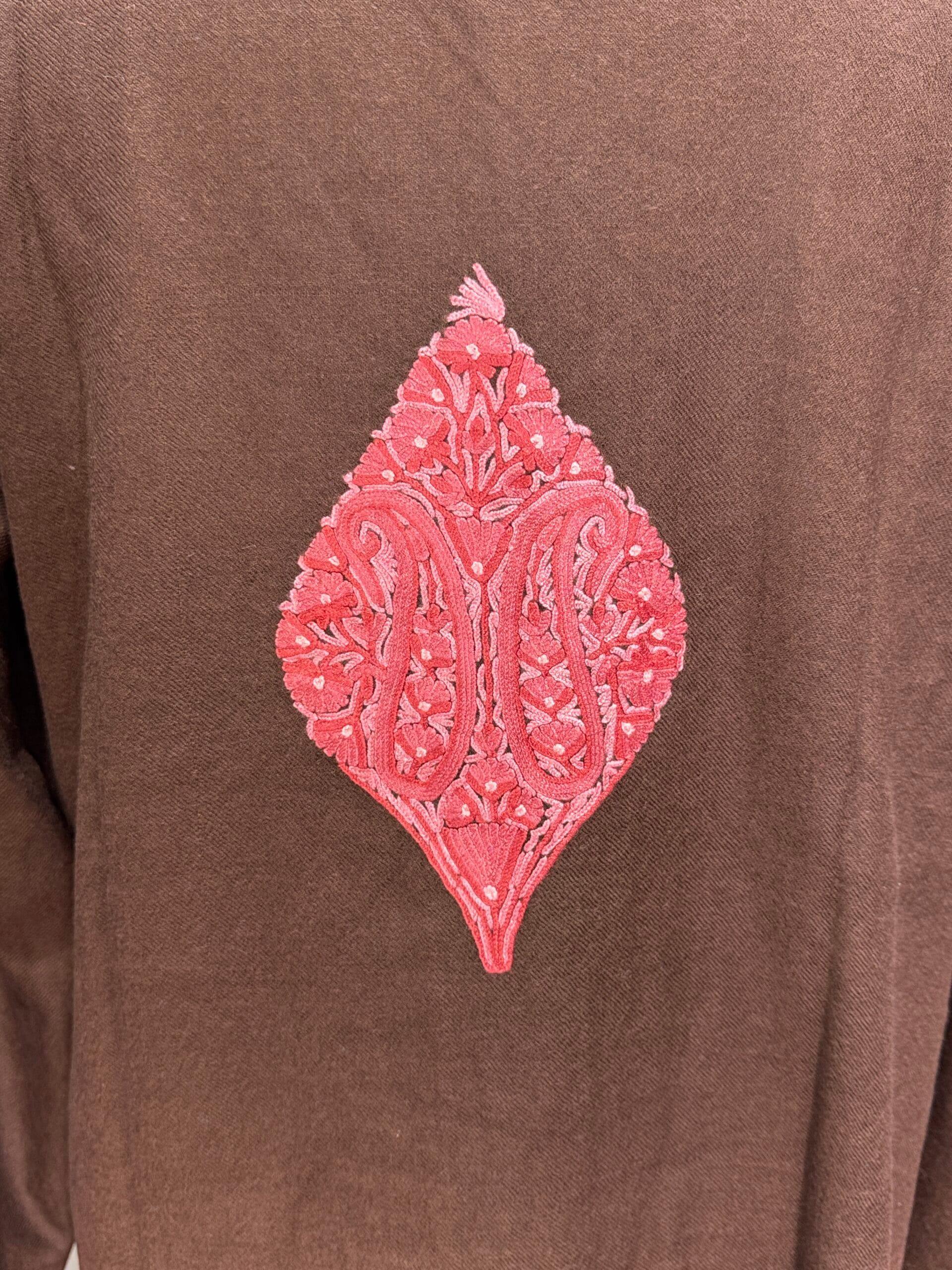
On pherans and kurtis, in stock
Part four
For most of its history the workshop embroiderer of Srinagar was a man: Biscoe in 1922 describes shop after shop of men at embroidery in silk, cotton or wool, and the craft still passes from father to son, boys apprenticed at eight or ten. The last thirty years changed the picture without changing the wage. In Kund, a village in Kulgam, Zamrooda Akhtar has trained around four thousand women in crewel work since the 1990s; a piece takes from a few days to ten weeks, and a trained hand earns four to five thousand rupees a month. In Srinagar's old city a woman who had done aari for twenty years told the Kashmir Times in 2025 that she earned twelve to fifteen hundred rupees a month, less than the few men in the same line. Those are the hands behind the cheaper end of the craft, worth remembering when the hand-worked piece costs more than the machine one.
Part five
Aari on wool wants the care of any wool, with one extra rule: turn the piece inside out first, so the chain does not rub. Woolmark's method is a hand wash in lukewarm water, about 30 degrees, with a mild detergent, ten minutes' soak, a rinse in lukewarm water and a second in cold. Do not hang it: lay it on a clean pale towel, knead it back into shape, and dry it away from sun and radiators. Press on the wool setting with steam while the cloth is still slightly damp, embroidery face down on a towel so the chain is not flattened. If a loop catches, ease it back rather than pull: a chain stitch is one continuous thread, and a pulled loop runs.
Questions, answered
Chain stitch worked with a hooked needle, the aari, on cloth stretched in a frame. The hook works from above and the thread is fed from below, so each dip pulls a new loop through the last. Kashmiris also call it zalakdozi.
Same hook, same stitch; crewel means wool thread, usually on furnishings: curtains, cushion covers and the felt rugs called namda. The two were registered as separate Geographical Indication marks in 2025.
Aari is a hook making a raised chain, fast enough to cover a whole yoke in days. Sozni is a fine needle making tiny flat stitches, slow enough that some shawls take years. Aari is at home on wool; sozni on pashmina.
The wool cushion covers and woollen jackets are hand worked; the wool silk scarves and most cotton kurtis and kaftans are machine chain stitch. Each listing says which, and where it says neither, ask us and we will check the piece.
Not under that name. The hook craft is covered by Kashmir Chain Stitch and Kashmir Crewel, filed in January 2023 and registered in 2025; the handicrafts department has said an aari and staple embroidery application is next.
Inside out, by hand, in lukewarm water with a mild wool detergent. Rinse, press the water out in a towel, dry flat away from heat, and steam press on the wool setting with the embroidery face down.
Sources: Textile Research Centre, Leiden, on ari embroidery and zalakdozi; the V&A on Indian embroidery; Asia InCH on crewel; Gaatha; Moorcroft and Trebeck, Travels in the Himalayan Provinces (1841), vol. 2, p. 187; Lawrence, The Valley of Kashmir (1895), pp. 224, 260, 377; Watt, Indian Art at Delhi (1903), pp. 392 to 393; Tyndale Biscoe, Kashmir in Sunlight and Shade (1922), pp. 59, 132; Goswamy, The Tribune, 2001; UNESCO Creative Cities; the GI registry; Greater Kashmir on the 2025 GI marks and the artisan register; Kashmir Times, 2025; 30 Stades, 2023; Woolmark on washing, drying and pressing wool.
PHOTOGRAPHY BY Kashmir Bloom